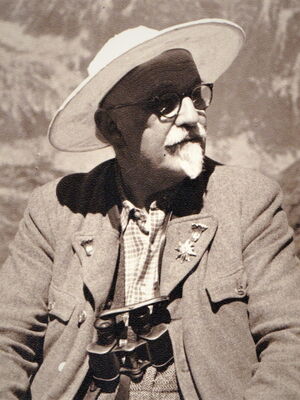
Max Moritz Wirth was born on 28th of June 1880 in Frankfurt am Main into a family which was intensely campaigning for democratic values and peace. His grandfather Johann Georg August Wirth had been one of the organizers of the Hambach Festival in 1832 and in 1848 a delegate to the Frankfurt National Assembly (parliament) in the St. Paul’s church.
Max M. Wirth’s father Franz Ulpian Wirth is regarded as the first patent attorney in Germany. He moved to Frankfurt in 1848, where he ran a very successful law firm. Together with his brother Max he founded the weekly paper “The Employer” (Der Arbeitgeber), from which in 1879 the journal “The Patent Attorney” (Der Patentanwalt) developed. In 1892 Franz Wirth withdrew from his profession as a lawyer and dedicated himself completely to peace movement. He was a co-founder of the German Peace Society (Deutsche Friedensgesellschaft, DFG) and acquainted with Bertha von Suttner (Austrian pacifist, Peace Nobel laureate).
Max Moritz Wirth had two brothers and three sisters. On 25th of May 1909 he married Marie Sophie Schneider, born in Hanover end of 1879. The couple lived in Frankfurt for many years at the street Am Lindenbaum 14. As his father, Wirth became a patent attorney. His law firm was located at Taunusstreet 1, led together with his older brother Richard (born 1865).
Max Moritz Wirth's father Franz Ulpian Wirth was one of the first members of the Alpine Club’s Frankfurt section founded in 1869. Franz Wirth undertook many major tours in the Eastern and Western Alps and was elected to the section’s board already in 1870. Until around 1880 he was 2nd secretary.
Probably the father influenced his children with his passion for the mountains. Max Moritz Wirth’s sister Sophie (deceased in 1945) wrote about their shared father: "Hiking and sport was father’s lifeblood. At the end of his 50s he climbed the Mont Blanc, from where he laconically wrote: 'Dr. Petersen [Frankfurt section's chairman at the time] anorectic'. After his 70th birthday he hiked with us two youngest daughters by foot from Garmisch to the Zugspitze, where in 1896 only a small emergency shelter with guest book existed ... the last hours of descent in thick snow ... in total 3 days on the way!"
Max Moritz Wirth joined the Alpine Club in 1903. He was elected into the section’s leadership in 1913 and became 2nd chairman already in 1914. In 1919 he became chairman, succeeding the deceased Dr. Theodor Petersen, the legendary founder of the Frankfurt section. Afterwards Wirth continued for several decades as chairman or 2nd chairman and substantially determined the course of the club, until he stepped down from office in 1953.
Initially, for the Frankfurt section the interwar period was a time of growth. Wirth was an ambitious mountaineer with experience in the Western Alps and was noticed for his alpine ski tours already at the turn of the century. Under his leadership new groups were established, the section’s huts expanded and/or were modernized. The Alps attracted not only mountaineers aiming for pioneering performance any more, but in increasing numbers also tourists who just enjoyed hiking. In Frankfurt the lectures and hiking excursions of the section as well as its annual winter festival became "magnets" for the city’s society. Apparently new joiners were close to Wirth’s heart – indicated e.g., by him finding many laudatory words in the section news about the new, rapidly growing student group of the section, which fell victim to alignment with Nazi ideology after 1933.
Already in the years prior to 1933 anti-Semitic tendencies in the entire Alpine Club grew stronger, especially in the Austrian sections. Many sections had already adopted exclusion clauses in the form of "Aryan Paragraphs". By contrast, Frankfurt’s section at this time practiced a completely natural cooperation between Jewish and non-Jewish members. This influenced also Max Moritz Wirth, who repeatedly represented the section during this period in the steering committee, the highest institution of the main club.
These conflicting attitudes became apparent during the severe conflict about the Donauland section, which mainly had Jewish members. It had been founded in 1921 in protest against the increasing anti-Semitic agitation within the main Alpine Club and many of its (mostly Austrian) sections. The massive attempts of anti-Semitic sections to convince the generally Donauland-sympathetic steering committee of their cause was commented by Wirth as Frankfurt’s delegate in 1922 with the words: "The approach of these sections is unbelievable, and should be stigmatized in the general assembly." But the anti-Semites finally came out on top: At the steering committee’s ballot end of 1924 regarding the exclusion of section Donauland, Wirth was the only delegate who voted against. At the following general assembly Frankfurt belonged to the small minority of 16 sections, which could not prevent exclusion by voting "No".
At the time of the NSDAP takeover in 1933 Dr. Max Moritz Wirth was chairman of the Frankfurt section and its delegate to the steering committee of the German and Austrian Alpine Club (DuOeAV), later he became deputy/second chairman. Therefore, he had material influence on the section’s directional change: From 1933 onwards it very rapidly adjusted to National Socialist ideology – the survival of the club was the upmost priority, and for this the connection to and solidarity with its Jewish members was sacrificed. Wirth himself never joined the NSDAP party; but he was member of the National Socialists Peoples Welfare (Volkswohlfahrt, NSV), the NS Law Protectors League (Rechtswahrerbund), the NS Imperial Warrior League (Reichskriegerbund), the NS Associationfor German Technology (NS-Bund Deutscher Technik) and the NS League for Physical Exercise (Reichsbund für Leibesübungen, NSRL).
The well-being of the club was the highest priority for Wirth, which became obvious already at the session of the DuOeAV steering committee in May 1933. There he pointed out that the club’s future would depend heavily on its handling of Jewish members. He reminded that an influence of the Nazi regime on the club’s leadership "would not have to be worried about if same is free of Jews". Finally, the committee agreed to his proposal, advising sections, which had not yet adopted an "Aryan Regulation", to incorporate a ban for the joining of "persons of Jewish origin (as per the definition of the official regulations effective in the German Reich and with the respective exceptions)" into their statutes.
It looks like already in March 1933 Dr. Arthur Kutz, a long-standing Jewish member of the Frankfurt section’s board, fell victim to this course emphasized by Wirth. Kutz, who belonged to the section’s leadership since 1907, was not reelected. Officially it was said that the famous gynecologist had declined his reelection himself "because of overwhelming professional demands". But later comments of Kutz hint toward a clear mortification.
But also Wirth himself was affected by the disruptions. After the whole section board resigned in summer 1933 because of the new political situation, it was planned to hold an irregular general meeting in July to elect a new section committee. The previous chairman (Wirth) ran for office again, together with district court counsel Dr. Ernst Wildberger and trainee teacher Walter Baecker. Wirth actually got the majority with 89 out of 191 votes, but did not remain in office for long. Already in September the 33-year-old Wildberger, runner-up in the election and NSDAP member, declared himself to be the new "section leader".
The background to this cannot be completely clarified any more. But Wirth himself wrote in a letter presumably to the steering committee and the main Alpine Club: "I made allowance for the new time and have resigned." In 1946 he declared during his denazification proceedings that he "as chairman of the Alpine Club had been forced by the (NSDAP) party into resignation".
However, the patent attorney never turned his back on section leadership but remained connected as deputy within the section board in responsible position; 1934 at the side of Dr. Rudolf Seng, who was (NSDAP) party member like Dr. Ernst Wildberger, and from 1934 onwards Wildberger's successor as section leader. After 1933 Wirth initially also remained for a while "Representative of the 'Fuehrer' for the district of the Southwest German sections". In the section news repeatedly hiking reports written by him can be found. In autumn 1944 he belonged to a small group of section members, who – despite the by now heavily raging war - could not refrain from celebrating the section’s 75th anniversary with a gathering at the Gepatschhaus, an alpine hut owned by the Frankfurt section.
Although Wirth no longer represented the section in the main Alpine Club’s steering committee, he indeed cooperated closely with Seng, and apparently in mutual respect, as indicated by statements of Wirth after the war. Did he also know about the unlawful expulsion of section member Dr. Ernst Meissinger because of his Jewish mother, driven by Seng? This violated the regulations valid in 1935, stipulating that so-called "Mischlinge 1. Grades" must not be excluded. It is unknown to us, whether Wirth was involved in this act – however it seems possible, in light of his overall behavior heavily adjusted to the new political situation, that he probably would have tolerated the expulsion.
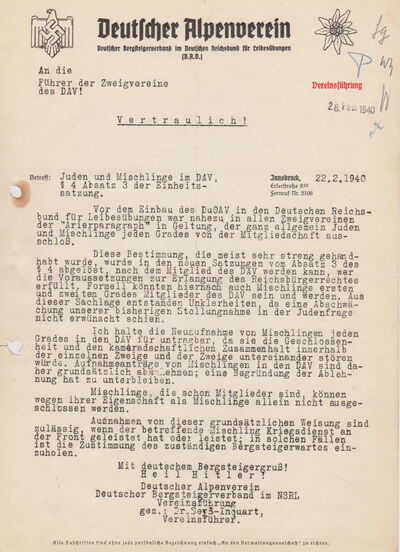
Although the section by then was already organized strictly hierarchically, and the "section leader" held a lot of power: Important information was shared amongst all members of section leadership. As was a letter to all section leaders, marked "confidential", from Arthur Seyß-Inquart, DAV leader and within the NS regime Reich governor of Austria among other functions. It is dated 22nd of February 1940 and carries the subject line "Jews and Half-castes in the German Alpine Club" (Juden und Mischlinge im DAV). In this letter Seyß-Inquart forbids the new subscription of so-called "Mischlinge jeden Grades". But "Mischlinge" who were members already could not be expelled on these grounds only. Knowledge of this letter was acknowledged by initials, beside from Rudolf Seng also from his deputy Max Moritz Wirth and others. This suggests that the exclusion of people with Jewish origin was supported by section leadership in general collectively.
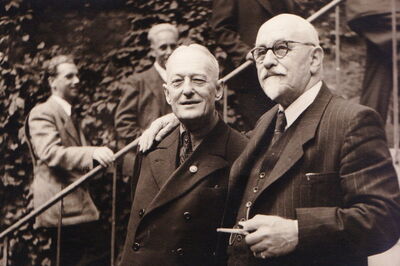
After the war Dr. Max Moritz Wirth was the driving force for the section’s reestablishment, amongst others together with Fritz Peters, who also had held important positions within the section during the whole Nazi era. A self-critical reflection on the collaboration with National Socialism did not take place, neither by individuals nor by the club at large. Rather it was also Wirth’s objective first and foremost to rebuild the Frankfurt section and the Alpine Club as a whole and to repossess the huts in Austria as soon as possible.
On 7th of April 1946 the section held a general meeting, the first after three years, to initiate a new start and elect a new board. Because section leader Dr. Rudolf Seng died in the fighting for Frankfurt under unexplained circumstances just before the end of war, Max Moritz Wirth led the meeting as provisional chairman. He verbalized in haunting words that the meeting was emotionally very moving for all, after the club’s networking contacts had ultimately been destroyed by massive war damages: "I am delighted that today so many dear, old faces are back again, in which I can see the eagerness to learn what our good, old Alpine Club will become." Wirth also remembered that probably around 250 section members had died during the war – which would be more of 10 percent of the club’s membership.
The absence of any self-critical reflection on the most recent club history became acutely obvious when Wirth appreciated Dr. Rudolf Seng as a person. Seng, who joined the NSDAP (party) very early on and maintained good relationships with representatives of the Nazi regime, appears in Wirth’s narration exclusively as somebody who protected the club in the Nazi era and advocated with all his might. According to Wirth: "With great diplomacy he often managed to deflect unpleasant enforcement from the new Reichs- (Nazi)-organizations or to let it fizzle out." Wirth also indicated that apparently heavy accusation were raised against Seng posthumously – but he denounced these as "shameless and felonious rumors" targeted at "wanting to impair his (Seng’s) reputation". About himself Wirth said having in 1933 "been forced to abdicate after fifteen years of club leadership".
Even more striking is especially Wirth’s denegation of the so-called "Aryan Paragraph" in his speech at the first general meeting: "The Alpine Club is an apolitical association and does not tolerate any, however oriented [sic] politics within its rows insofar the official work of the Alpine Club is concerned", he emphasized and continued: "We also did not participate in the race related issues. Neither have we agreed with the 'Aryan Paragraph' in those days, nor have we removed members for racist reasons." Therewith he knowingly told the untruth about the section’s course since 1933. Behind it was perhaps the consideration that this was possibly the only way to obtain approval from the US occupying forces for readmittance as a club (here for additional reading: Wirth’s statement in April 1946 and exemplary the 1934 change of statutes with the adoption of the "Aryan Paragraph").
In this general meeting Wirth was finally elected as first post war chairman of the section, Fritz Peters as secretary and Hans Urban was appointed as treasurer. Dr. Kurt Blaum became second chairman.
Like any other German above the age of 18, also patent attorney Dr. Max Moritz Wirth ran through denazification procedures soon after the war. In the respective questionnaire he classified himself as "exonerated person": He justified this on one hand with his memberships in Nazi organizations (NS Peoples Welfare NSV, NS Law Protectors League, NS League for Physical Exercise NSRL, NS Imperial Warriors League and NS Association for German Technology) being based on the precursor organizations’ enforced take-over by the National Socialists. On the other hand he stated to have been "forced by the NSDAP (party) to resign as chairman of the Alpine Club." During the process "detailed investigations inside the living quarters of the concerned" happened. However, according to the final report dated 19th of March 1947, "no liability" of Wirth was found. The proceedings were closed.
In 1953 he, then 73 years old, stepped down from his functions in the Alpine Club. At this point in time he was a section member for 50 years and appointed honorary chairman for his "huge contributions for the benefit of the club". The passionate skier was also honorary member of the German Ski Association (Deutscher Skiverband).
Wirth passed away on 29th of March 1957 at the age of 77 years. Dr. Kurt Blaum appreciated him elaborately in an obituary, printed in the Frankfurt section news as well as in the nationwide DAV journal. Blaum emphasized Wirth's decades-long commitment, his bond to the section’s area in the Kaunertal, his accomplishments as an early pioneer of skiing, together with his humane warmth and the ability to mediate and be a role model and mentor for the younger ones. The entanglements during the Nazi period were not brought up. They were also still missing twelve years later in 1969, in the review of the era Wirth within the publication (Festschrift) on the occasion of the section’s 100 year anniversary.
From today’s perspective, this perception needs to be amended. Because when reassessing the NS period the picture of a man emerges, who possibly was no committed National Socialist – but who made the continued existence and survival of the Alpine Club during the Nazi era the dictum for his actions as club official. Wirth belonged to those, who not only tolerated the ideological alignment (Gleichschaltung) of the club, but also actively helped shaping it. Thereby he actively contributed to the exclusion of members persecuted as Jewish.
Quellenangaben
Archives of the German Alpine Club
Archives of the DAV section Frankfurt am Main
Historical archives of the Austrian Alpine Club (minutes of the steering committee meetings in July 1922 in Bayreuth and in May 1933 in Innsbruck)
German Biography (Deutsche Biographie, last accessed on 31. Aug. 2026): information regarding Franz Ulpian Wirth
Hessian Main State Archive (Hessisches Hauptstaatsarchiv Wiesbaden) - HHStAW, Bestand 519/3, No. 22835 and 676, No. 4768
Journal of the German Alpine Club (Mitteilungen des Deutschen Alpenvereins) 1953
Müller-Wirth, Christoph: For Freedom and Peace. Published in: Forum Pacifism 38, 2. Quartal 2013 (Magazine of the DFG-VK e.V. and others): information regarding Franz Ulpian Wirth (last accessed on 31. Aug. 2026)
Publication (Festschrift) on the occasion of the 100 year anniversary of the section Frankfurt am Main ("Festschrift 100 Jahre Sektion Frankfurt am Main. Sektion Frankfurt am Main des Deutschen Alpenvereins"), 1969. Last accessed 31. Aug. 2026
Frey, Martin: Chronical of the section Frankfurt am Main. Publication is imminent
Maier, Max Hermann: Interwoven with us deeply and wonderfully. Reminiscence of Germany ("In uns verwoben, tief und wunderbar. Erinnerungen an Deutschland"), Publishing house Josef Knecht, Frankfurt am Main 1972
Section news (Nachrichten-Blatt der Sektion Frankfurt am Main), volumes since 1930 (e.g. Section news 3/1934: statutes addition "Aryan Paragraph" February 1934), online accessible