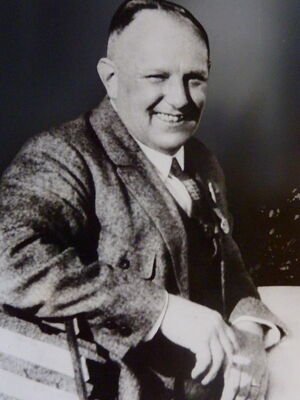
Rudolf Seng was born on 12th of May 1893 in Frankfurt am Main as son of Karl and Johanna Seng. In his youth he lived at Schweizer Platz 49 (for some time called Gustav-Adolf-Platz) in Sachsenhausen, where he also attended secondary school (Oberrealschule). Seng participated in World War I and was wounded several times, he received the Wounded Badge in Black and the Combatant Cross. After the war he studied in Munich, Frankfurt and Göttingen the subjects natural sciences, chemistry, economic and social sciences. On 24th of June 1920, by now at age 27, he finished his academic studies obtaining a doctorate in chemistry. One year later, 1921, Seng married Franziska Schwing, and it looks like he remained living with her in Frankfurt for the rest of his life, where he worked as a chemist. During WW II he also led a branch of the air-raid protection police. Seng died when Allied forces came near to his place of residence in Sachsenhausen en route marching into Frankfurt. According to his death certificate he was shot on 26th of March 1945 at 4pm (16:00).
Dr. Rudolf Seng joined the NSDAP (Nazi party) already in March 1933 and was also member of several other Nazi organizations e.g., the National Socialist People Welfare (Volkswohlfahrt), the National Socialist War Victims Care (Kriegsopferversorgung) and the NS Student League (Studentenbund).
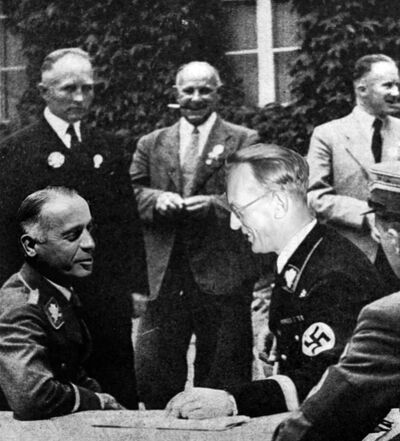
Dr. Rudolf Seng is certainly one of the key figures during the Nazi era. He significantly steered the Frankfurt section through the 1930s and 1940s, restructuring leadership board and club activities during these years. Furthermore, as section leader he was responsible for Nazi ideology implementation, which also included the question how to treat members persecuted because being Jewish. That he obtained this position of power was not only caused by his strict loyalty to NSDAP party principles and his good connections to high-ranking officials but also by his decades of membership in the Alpine Club.
Seng joined the Alpine Club in 1920, probably while still a student or just directly after his graduation. Already in 1922 he was appointed as member of the board, and in 1925 he took over the role as mountain guide instructor (Führerreferent). One year later, in 1926, the responsibility for mountain huts (Hüttenreferent) followed, a function he kept also after his election to section leader in 1934. Especially for his activities as hut supervisor Seng was very much appreciated by the section. One of his tasks was e.g., dealing with the increasing winter tourism in the 1920s, and for handling same Seng strongly called for a new consultancy position on federal level. Also as section leader he advocated in 1935 for the re-establishment of a skiing group.
Game-changing was Seng's election to section leader in February 1934. The increasing alignment of individual Alpine Club sections to NS doctrine had finally forced this internal restructuring. From now on one single leader should independently direct all section matters. However, the first leader was not Seng, but Dr. Ernst Wildberger (age 33), who had not made much of an appearance in the section before. His appointment may have not happened in a completely correct way, but nowadays we cannot look behind the scenes any more: Actually the long merited chairman Dr. Max Moritz Wirth had been elected as acting leader in September 1933, but did subsequently decline for personal reasons – perhaps he was forced to do so.
Wildberger was not leader for long, possibly because already one year later he took over the leadership of districts XII (Upper Hesse) and XIII (Southwest), and therefore was not available for reelection any more. Dr. Rudolf Seng was unanimously elected as his successor. In his first article in the section news from March 1934 Seng urged, still without the National Socialist pathos of his later years, the members to preserve "calm and discipline" and in doing so might potentially have meant also to call his adversaries to order. At the first session of the advisory council Seng finally appointed the members of the board and essentially confirmed the selection of his predecessor Wildberger. Amongst these were e.g., Fritz Peters as editor of the section news (Nachrichtenblatt), Max Tasche leading the scientific department and Dr. Wildberger in charge of legal affairs. Two of his decisions are especially worth noting: Max Moritz Wirth became Seng"s deputy, and Dr. Kurt Blaum responsible for presentations. Blaum had previously been removed by the National Socialists from his office as lord mayor of Hanau because he insufficiently advocated Nazi party doctrine.
With the election of Seng the section incorporated the "leader principle" also in its statute, which still had to be retroactively adapted in February 1934 – strictly speaking Wildberger and his board had been in office unconstitutionally. From then onwards all important decisions felt to the section leader, who was elected every three years. Furthermore, the "Aryan Paragraph" was added in paragraph 3 (§ 3 of the section statute), which defined the treatment of members persecuted because being Jewish (see also the attachment below).
Outside the section Seng was also active in the overarching German Alpine Club and held some offices there. From 1934 onwards he was area warden for the Ötztal and Stubai Alps as well as member of the main council. Two years later he additionally became for the NSRL (Reich Association for Physical Exercise, Reichsbund für Leibesübungen) district warden of mountaineering for the districts Electorate Hesse (Kurhessen), Hesse-Nassau and, starting 1941, for the district Western March (Westmark).
During his whole time as branch/section leader (Zweigführer) Seng got very much involved in the club"s activities. He led hiking excursions himself, gave presentations and organized popular section festivities like i.e., folk and winter festivals. He was especially recognized for his commitment regarding the clubhouse Oberreifenberg in the Taunus range. Seng succeeded in 1935 to lease this hut from the "German Workfront" (Deutsche Arbeitsfront) for 70 RM per month – most probably thanks to his contacts to the NSDAP (party) having expropriated its previous owner, the association "Youth Center of the Christian Unions". In 1938 the section was eventually able to buy the house, but it did not remain its property for long. Already in 1941 it was confiscated for use by the Hitler Youth (Hitlerjugend).
Section"s activities ended latest after two air (bombing) raids early in the year 1944. On 3rd of April 1944 Seng impressively described the magnitude of destruction in a letter to the Alpine Club"s leadership in Innsbruck:
"I have to send you the mournful notification that the city of Frankfurt am Main [...] is a thing of the past [...] The complete social and business life lies idle for months to come, no means of transportation are in working order, and there is also no gas, no (drinking) water, no electricity, no telephone, no mail service etc. available. Frankfurt itself is in the truest sense of the word a dead city [...] The fate of the gentlemen in my section board is up to now still unknown to me [...] The section office with just restored ability to function is mostly destroyed, as well as the office of Mr. Wirth [...] How the lives of the remaining inhabitants, it is a very small number, is meant to continue still remains to be seen, as well as how to possibly continue the work of the branch/section Ffm (Frankfurt) ..."
Only in April 1946 the section could meet again to elect a new board and adopt new statutes for itself.
As section leader Seng was significantly responsible for the expulsion of Jewish members, as far as these had not yet left on voluntarily basis. There exist no complete membership rosters from the 1930s years, but it is clearly obvious from the club report of the year 1933, that the membership numbers were shrinking. This was not only related to the poor economic conditions, because at that time there was a travel ban to Austria in force, which made visits to the section owned mountain huts impossible; the decreasing numbers were also caused by exits of a "number of non-Aryan members" as reported in the section news (Nachrichtenblatt). Who was "Aryan" and who "Non-Aryan" was defined since 1933 by the so-called "Aryan Paragraph". Among other aspects it also limited new membership subscriptions to individuals defined as "Aryan" only. However, members persecuted as Jewish were not meant to be expelled, a regulation also confirmed by the headquarter of the Alpine Club and only tightened with the uniform statutes for all club sections of 1942.
But Seng demonstrably disregarded this regulation. Once he learned that member Dr. Ernst Meissinger was born to a Jewish mother, he contacted the superordinate administration committee of the Alpine Club, which confirmed the "non-Aryan" descendance of Meissinger to him. Subsequently Seng requested Meissinger in the year 1935 to leave the section. When Meissinger refused, Seng decided his exit on his own.
Up to now Dr. Ernst Meissinger is the only example, whose forced exclusion from the section is well documented, but it can be assumed that there was massive pressure exerted also on other members defined as Jewish to leave the section. Many did so voluntarily to avoid the increasing anti-Semitic and national atmosphere within the club.
Under Seng's leadership the Frankfurt section became aligned to National Socialist ideology. This included the restructuring of the athletic programme: Sporting activities got a paramilitary touch, like can be seen e.g., from the drilling exercises of the young men group (Jungmannschaft). In addition, Seng used in particular the section news to spread National Socialist propaganda.
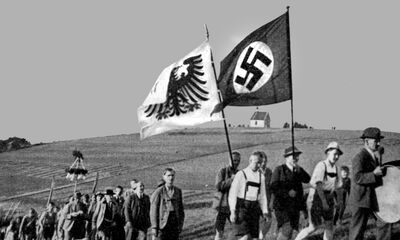
Especially the opening ceremony of the club house in Oberreifenberg in October 1935 was marked by the Nazi swastika. One hiked with a "happily flapping" swastika flag towards the new hut, and during his speech Seng repeatedly rendered homage to the Führer as a "shining beacon, [...] who loves the mountains above all". With similar pleasure the forced integration of Austria in March 1938 was welcome and the renaming of the DuOeAV (German and Austrian Alpine Club) to "German Alpine Club" that followed.
The start of WWII on 1st of September 1939 was celebrated by Seng with National Socialist propaganda diction:
"In Poland our glorious armies beat back the rollicking attack of the Polish government turned megalomaniac."
He proudly emphasized the section members" preparedness to fight "at the front line for people, fatherland and Führer" and pointed out that especially the mountaineers had "worked unswervingly for the now accomplished goal of a large German empire (großdeutsches Reich)" (Section news no. 9 dated September 1939, page 97). Also in his Christmas address 1940 Seng praised the "energy of the German armed forces (Wehrmacht)" and idealized the heroism and the loyalty of mountaineers supporting "a new and better future for the German people".
The first post war meeting of section members in April 1946 served only to a minor degree coming to terms with the years of Nazi dictatorship. Not only every ideological or actual participation in NS structures was denied, but also the function of section leader Seng (positively) exaggerated. Max Moritz Wirth, the provisional chairman, said in his speech to the general assembly:
"It is regrettable that – it cannot be phrased otherwise – shameless and criminal rumors have led to attempts in lessening his reputation [...] The year 1933 arrived, and the new political course began to reign by force and orders and I had been forced to resign after fifteen years of section leadership. Mister Dr. Seng was the default successor in this instance, because he alone was able, despite the new government directives, to arrange that he could honor the old ideals of the Alpine Club and not letting these be diluted and flattened out. With great diplomacy he often managed to avert annoying enforcement coming from the new Reich organizations or to let same simply fizzle out[...]." (Minutes of the address to the 74th general assembly on 7th of April 1946, page 3).
Sources and Literature
Section news (Nachrichten-Blatt der Sektion Frankfurt am Main)
Martin Frey, Chronicle of the section Frankfurt am Main, to be published in near future
Photo gallery
No images available.