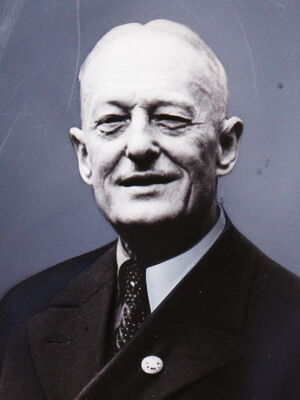
Fritz Peters was born on 16th of August 1885 in Ingolstadt (Upper Bavaria). About his childhood and adolescence we have no information yet. His wife Charlotte, née Lübeck (born 24. September 1881) hailed from Saint Avold (Lorraine, at that time part of imperial Germany). For many years Peters was editor at the gazette "Frankfurter General-Anzeiger", also during the Nazi era. He joined the Frankfurt section of the Alpine Club in 1921 and held leading functions for many years, until 1952. He is honorary member of our section.
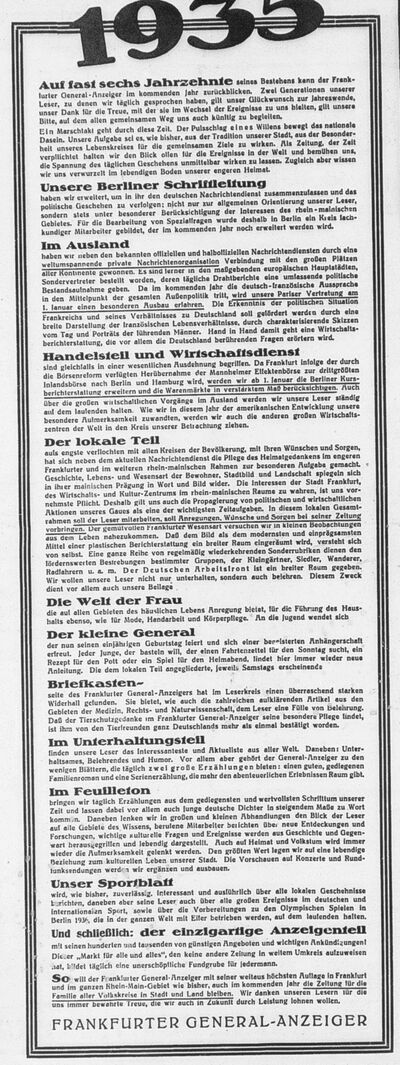
Up to now it is unknown to us in exactly which capacity the editor Fritz Peters worked at the "Frankfurter General-Anzeiger". The gazette was published from 1876 to 1943 under different names and was for some time the city"s newspaper with the highest circulation. For years it had a wide readership ranging from (blue collar) workers to middle class, with a local focus and a large advertisements section. During the Nazi era it followed an apolitical adapted course.
Already in 1933 the National Socialists massively extended media censorship and freedom of press was actually not existent any more. The framework they created resulted in allowing only those to continue working, which did not deviate from the Nazi party"s direction.
On 1st of January 1934 the so-called "Editor Law" (Schriftleitergesetz) came into effect. Afterwards, former editors were now called "Schriftleiter"; he or she had to have citizenship of the German Reich and had to produce proof of Aryan origin (Ariernachweis). Foreign nationals, German citizens of Jewish faith and persons married to a partner of non-Aryan origin therefore were not allowed to work journalistically any more. According to estimations of the Federal Center of Political Education (Bundeszentrale für politische Bildung), about 1,300 Jewish or otherwise unwelcome journalists lost their job.
The Reich Federation of German Press (Reichsverband der Deutschen Presse), the professional association of journalists and editors, was aligned to Nazi ideology in 1933. It was put under the authority of the Ministry for People Education and Propaganda (Volksaufklärung und Propaganda) and added to the Reich Press Chamber (Reichspressekammer). Everyone wanting to work journalistically had to be enrolled in a list of professionals maintained by the Reich Federation of German Press. Therefore, a large part of censorship already happened by member selection.
Fritz Peters was not only an ordinary member of the Reich Federation of German Press. It appears he held functions in the Federation, as indicated by documents in the Hessian Main State Archive (Hessisches Hauptstaatsarchiv): Apparently he was member of the Supreme Leadership Council (Großer Führerrat) as well as leader of the Federation"s district Rhein-Main. The task of the districts was to monitor compliance with the regulations of the "Editor Law" in their area. Exactly how much Peters was involved into this will be a topic of further research.
Furthermore, there are leads to publications of Peters in the "German Press" (Deutsche Presse), the member journal of the Reich Federation, which we look into.
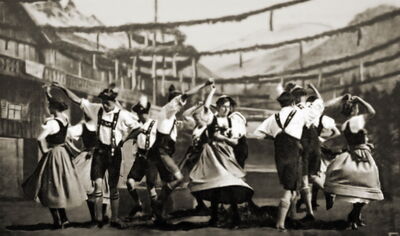
From the end of the 1920s until way into the years of WWII Fritz Peters held an important position within the section. He led the festival committee and made history in the club as the one who organized the increasingly successful annual alpine club festivals of the section. These became a magnet for Frankfurt"s society with some attracting more than 1,000 guests. At these events repeatedly wind orchestras from Tirol as well as dancing and Schuhplattler (Bavarian folk dance) groups performed. Peters played music himself and apparently possessed quite some talent as entertainer. Section news No. 1, 1931 (Nachrichtenblatt 1, 1931) describes a sociable gathering of the section"s newly founded student group, where Peters shared "some samples of highly amusing Bavarian humor" and also, together with another member, played "a few proper pieces of music with zither and lute".
From the mid-1920s, Peters also took over the development and editorship of the section's new newsletter (Nachrichtenblatt). Therefore, he was the responsible editor of the section news – also when it contained an increasing amount of National Socialist propaganda during the Nazi era.
Within the section's board, called "Leader Council" (Führerbeirat) since 1933 and no longer elected but appointed by the section's chairman, Peters held also the position as secretary.
Occasionally the editor himself published in the section news, too. E.g., in issue November 1935 there is a report signed by the initials "fp" about the ceremonial inauguration of the new section house in Oberreifenberg (Taunus). Therein Peters gives a detailed account of section chairmen Rudolf Seng's address:
"Finally, Dr. Seng flagged the bright example of our Führer Adolf Hitler, who loves the mountains over all, and time and again draws renewed power and finds recreation for his giant actions in the mountains of the Berchtesgaden country (Upper Bavaria). It had been Adolf Hitler, who pulled the German sport out of shallowness and from some individuals' greed for records, and who reinstated the purpose it should have actually always had have: to be a fountain of youth for our German nation."
According to the author Fritz Peters this was followed by a triple "Sieg Heil".
At the end of 1939 there is a floundering report of Fritz Peters in the section news covering the "memorable" general assembly of the German Alpine Club in Graz (Austria) in summer 1939, attended by a large delegation traveling from Frankfurt. The text emphasizes the constantly growing amalgamation between Alpine Club and National Socialist targets and the club's function as elite training center for the "Wehrmacht" (German Armed Forces). Peters provides extensive space for the words of Nazi minister and Alpine Club leader Seyss-Inquart:
"The entire human being, according to Dr. Seyss-Inquart, is part of the great task, of the nation's existence, but the [only] valid way of life should be fighting the enemies and [obtaining] intrinsic verification and assertion. This would also be the meaning of the task received by the German Alpine Club through the fact of being the exclusive association for German mountaineers responsible for every aspect of mountaineering in Germany for all German comrades. Mountaineering would be [...] an excellent means of ideological and political education with the goal to continuously assure the nation in its racial and the state in its national status."
The annexation and assimilation of the Sudeten area and the Lithuanian Memel region by the Nazi regime was described in the article, using propagandistic rhetoric, as "homecoming". The members of the Frankfurt section also read that the Alpine Club considered "it as one of its paramount targets to supply physically suitable and mountaineering skilled future leaders for the mountain infantry of the army."
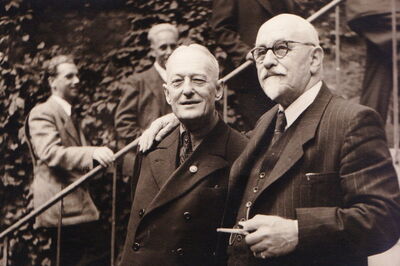
As the war ended in 1945 Fritz Peters was 59 years old. Up to now we have no information if he worked in any capacity afterwards – also not about the course of his denazification process.
In the rebuilding of the Alpine Club's section Peters played, beside Max Moritz Wirth, a crucial role from the start. During the first general meeting in 1946 he again became the section's secretary and from 1949, when issuing the section news (Nachrichtenblatt) was restarted, he also continued as its editor.
That the club was extraordinarily important in his life became apparent as the married couple Peters allocated the ground/first floor of their house at Oberlindau 63 in 1949 to the Frankfurt section for use as offices and group meeting rooms. In 1950 the Peters bequeathed their whole building to the section after their passing. Two years later Fritz Peters stepped down from his club functions for reasons of age. A few months later the section granted him honorary membership – for decades of dedicated service and his patronage.
Fritz Peters died on 13th of March 1964.
Sources and Literature
Archive of the Alpine Club section Frankfurt am Main
Federal Center of Political Education (Bundeszentrale für politische Bildung): Zum NS-Schriftleitergesetz: Journalisten als Staatsdiener, last access on 04th of April 2022
Frankfurter General-Anzeiger: Microfilm, University Library Frankfurt am Main, call number MF 24286
Hessian Main State Archive (Hessisches Hauptstaatsarchiv), tax file: HHStAW, 676, 4785, period: around 1930-1945
Historical Museum Frankfurt am Main, exhibition "Frankfurt and the National Socialism – a city joins in"
Section newsletter, online accessible
Photo gallery
No images available.