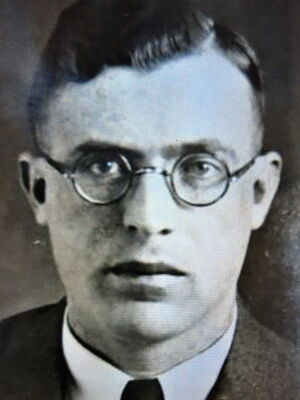
Max Tasche was born on 8th of October 1909 in Vilseck (Upper Palatinate). His parents were Walter and Johanna Tasche, née Keller. His father was registered manager at Terranova-Industrie (now part of Compagnie de Saint-Gobain).
In 1913 the family moved to Frankfurt am Main and at that time resided at Raimundstreet 68. Max Tasche attended the Ziehen secondary school until March 1928 when he passed his final exams. Because wanting to become a teacher, in summer semester 1928 he started studying natural sciences at the Goethe-University in Frankfurt (geography and physics, with mathematics and philosophy as minor subjects), which he finished in winter semester 1932/33. His preparation service for school-teaching started in October 1934 at the Muster school in Frankfurt/Main. Further months of preparation service at other schools in Frankfurt followed. In May 1934 he passed the scientific and in September 1936 the pedagogic examination for teaching posts at secondary schools. Subsequently he received the certificate of appointment as graduate lecturer civil servant (Studienassessor). Already in June 1933 Max Tasche received his doctor degree (Dr. phil. nat.) for his PhD thesis "Morphology of the river Iller’s source area" (Morphologie des Illerquellgebiets).
On 25th of January 1939 Max Tasche married in Frankfurt the 24 year old commercial employee Hedwig Hinkel. Three children arose from this marriage. For example the section news (Nachrichtenblatt) reported in June 1941 that a daughter was born to Dr. Max and Hedy Tasche.
In the following we first describe his engagement in Nazi organizations together with his years during war and post-war. Afterwards the chapters regarding his time in the Alpine Club follow.
As member of the NS student league (Studentenbund) Max Tasche joined the NSDAP on 27th of April 1933, local branch Frankfurt-Ginnheim. At the same moment he also joined the SA (Sturmabteilung), where he was promoted to squad leader within the so-called "Nachrichtensturm 3" of the SA-Flag 63. This SA-Flag not only ran a rogue concentration camp in the former Westendheim on Ginnheimer Landstrasse from April 1933 onwards, but his squad "Sturmbann III/63" also participated in October 1941 in the deportation of 1000 Frankfurt Jewish citizens to the ghetto in Litzmannstadt (Lodz, Poland). Furthermore, Tasche was member of the National Socialist Teacher League (Lehrerbund, since 1935) and of the Imperial Colonial League (Reichskolonialbund, RKB, since 1938). He also explicitly mentioned these political activities in his application for a high school teacher position in 1938. In the following he worked amongst others at the Ziehen secondary school.
After Tasche was rated "fit for military service" (kv, kriegsverwendungsfähig) in his physical examination in March 1941, he tried intensely to obtain a deferment as "indispensable" (UK, unabkömmlich). However, he did not succeed. During WWII Tasche was deployed in France, finally with the rank of a sergeant. From August 1944 onwards he was sent to a training course in Köthen (Saxony-Anhalt) and, according to his own information, took part in combat "east of the Oder" (river). From April 1945 until October 1949 he was in Russian captivity as prisoner of war.
Starting 1949 Dr. Max Tasche went through the denazification process, initially in absentia because of his war captivity. His wife Hedwig argued in this regard that she, caused by her husband’s NSDAP membership, which led to his dismissal from school teaching, was "without any financial support" since June 1945. Since the currency reform in June 1948 she and her three children would only get welfare support, "but are unable to make a living from this".
The data we have show no evidence that Tasche’s advancement in the ideologically aligned Apline Club, e.g. his role as "Dietwart" (officer for the ideological education of sport club members), featured in his denazification process. The city of Frankfurt’s education authority issued a statement for this procedure. There it lists Max Tasche’s memberships in previous NS organizations and added at the same time that he "according to information from the teachers’ council of the school at which he lectured last, in no way emerged politically active".
On 1st of November 1949 the responsible "First Public Prosecutor" in the denazification process decided that Tasche fell under the "homecomer amnesty" because of his war captivity. Therefore, the proceedings against him were closed.
Shortly after, already two months after his return from war captivity, Tasche suffered a stroke. Initially, this prevented his ability to gain a foothold in school-teaching again.
In December 1951 he got a lifetime civil service appointment as lecturer for secondary schools. Already during the months before this, after he was able to slowly recover from his severe illness, he had taught at Ziehen secondary school for a few hours a week. However, Tasche was marked by his war injuries (stiffness of right hand, reduced vision) and a "nervous petulance", according to the head teacher of Frankfurt's Ziehen school. Therefore, repeatedly tensions between him and parents or pupils had to be mediated. Finally, Dr. Max Tasche was retired on 1st of August 1958. He died around two years later on 27th of November 1960.
Max Tasche joined the Frankfurt section of the German Alpine Club in the year 1930, together with his father Walter. At this time he founded together with other collegiate section members (e.g., Dr. Ernst Meissinger) the student group. At that time, the group still existed only unofficially.
The formal acknowledgement of the group happened shortly afterwards under the patronage of the leading section members Prof. Dr. Matthias Friedwagner and Dr. Kurt Albrecht. The provisional chairperson of the group was Ernst Meissinger. At the same time this group was also active at the university, where the professors Dr. Walter Behrmann and Dr. Hans Schrepfer took charge.
The function of liaison officer between section and university was also assumed by Ernst Meissinger. Max Tasche was one of his deputies. During these first years both probably worked closely together – until their paths separated caused by the club's alignment to Nazi ideology.
In June 1933 the privy councilor Dr. Matthias Friedwagner, since 1928 professor emeritus for Roman Philology at Frankfurt’s university, and Prof. Dr. Walter Behrmann recommended the admission of Max' brother Kurt Tasche, who was listed as "stud. ing.". So, he evidently studied engineering science.
From 1933 onwards, after the National Socialists came to power, Dr. Max Tasche got ahead with his career in the Alpine Club. In September 1933, the new section leader (Sektionsführer) Dr. Ernst Wildberger made him administrator for student and scientific questions. Shortly after, Wildberger was appointed as leader of the club's districts (Gaue) Hesse and Southwest. Hereupon Dr. Rudolf Seng succeeded him as section leader. Seng appointed Max Tasche to the section's advisory committee, where he was responsible for the scientific department. In addition, in the middle of the year 1935 Tasche became public relations officer of the club's district XII (Hesse).
In 1937 Tasche became appointed as so-called "Dietwart". In the National Socialist system the "Dietwart" was responsible for the political-ideological education of sport club members. In 1941 he additionally became leader of the section’s Youth group.
Within the section Tasche organized hiking excursions to interesting locations in Frankfurt's immediate vicinity, which were apparently well received because of his natural-historical and folkloristic explanations. Repeatedly, he also gave lectures for the section e.g., about "Mountain and valley configurations in the Eastern Alps", "Mountain hikes in Yugoslavia" and about "Bohemia".
We do not yet know if Dr. Max Tasche remained an active member of Frankfurt’s section also after the war.
Quellenangaben
Archives of DAV section Frankfurt am Main
Hessian Main State Archive (Hessisches Hauptstaatsarchiv Wiesbaden) - HHStAW, Bestand 650B, No. 3299
Section news (Nachrichten-Blätter der Sektion Frankfurt am Main des Deutschen und Österreichischen Alpenvereins), online accessible
University Archives Frankfurt am Main: UAF Bestand 146, No. 789
University Library: Frankfurt address books, online accessible