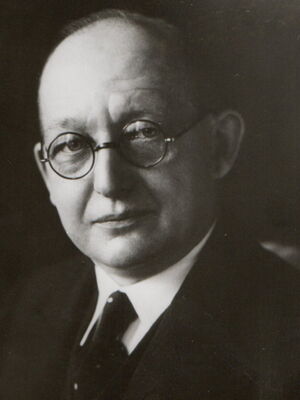
Kurt Albrecht was born on 24th of December 1885 in Burg near Magdeburg, administrative district Jericho, now federal state Saxony-Anhalt. Regarding his family"s origin and his schooling only sparse information exists. His father Friedrich was a teacher and head of the continuation school in Burg. About his mother, who died in 1931, there are no details found in the data evaluated.
On 29th of November 1920 Albrecht married in Frankfurt Else Irma Kühner, born on 24th of April 1892 in Karlsruhe. She was the daughter of Karl Kühner, who worked as subdirector at the German Life Insurance plc (Deutsche Lebensversicherungs-AG) in Berlin.
Kurt and Else Albrecht"s first child was born on 2nd of March 1926 but died within the same year. On 2nd of June 1927 the son Wolfgang Dieter was born. At this time the family resided in Hermesweg 22 in Frankfurt-Bornheim and moved soon after in the Rennbahnstraße in Frankfurt"s South. Before Albrecht finally ended up in Berlin for professional reasons in 1935, two years before the family moved into the Gutleut quarter close to Frankfurt"s central railway station (Wiesenhüttenplatz 26). After Else Albrecht passed away on 10th of September 1946, Kurt Albrecht married again on 24th of May 1952. There is we have no information about his second wife.
Since Easter 1895 Kurt Albrecht attended the secondary school (Gymnasium) in Burg and, because not getting promoted to the next (higher) class, moved on 30th of March 1901 to another one.
At the age of twenty Albrecht began to study law in Heidelberg. There he joined the fraternity "Allemannia", founded 1856, and continued to be a member for the rest of his life. From Heidelberg university, he moved after summer semester 1907 to Berlin university and from there, after summer semester 1908, to Marburg university, where he completed his studies. He passed his first state examination on 6th of April 1910 at the higher regional/appeal court (Oberlandesgericht) Kassel and was sworn as trainee lawyer shortly after. He fulfilled his military service, obligatory at the time, from October 1910 to September 1911 in the infantry regiment 88 in Schlettstadt (now Sélestat/Alsace, France).
Kurt Albrecht fought in World War I from 1914 to 1918. As combatant in a marksman squad he was wounded twice, but no war-disability remained later on. He received the decorations Iron Cross 1. and 2. Class, the Hessian Bravery Medal, and the Honorary Cross for Combatants. When the war ended he held the rank of a lieutenant.
Because of the disruption by WWI, Albrecht was only able to pass his second state examination on 7th of July 1920. At the same day he was appointed to court assessor. His law doctorate (Dr. jur.) was conferred just before (26th of February 1920).
Together with his wife Else Dr. Kurt Albrecht joined the Frankfurt section of the Alpine Club in 1921 and became an active and engaged member in the years to follow. He was entrusted with a number of committee functions within the section. Already four years after joining the section he became 3rd chairman and deputy secretary, another four years later (1929) together with Professor Friedwagner, deputy chairman as well as deputy for lectures, the library and the press, which was under the main responsibility of Fritz Peters. Additional functions temporarily held by him were book warden, delegate for legal questions ("the section"s combative juridical spine" ["das kampflustige juristische Rückgrat der Sektion"]), deputy procurator for the student group (together with Ernst Meissinger) and the skiing department.
His special concern was taking care of the section"s photographic collection, its inventory he continuously extended over the years, especially also with own pictures.
In July 1928 he attended, together with Prof. Friedwagner, as delegate of the Frankfurt section the general assembly of the German Alpine Club in Stuttgart. He was also delegated twice to conventions of the Southwest German Section Association as representative of Frankfurt"s Alpine Club.
During an academic ceremony in the auditorium of Frankfurt"s Goethe university on 17th of November 1929, Albrecht as deputy chairman delivered the commemorative speech marking the 60th anniversary of Frankfurt"s Alpine Club section.
After the section"s extraordinary general assembly on 17th of July 1933, which resulted in office holder (and political) realignment, Dr. Kurt Albrecht was no longer member of the section board.
However, Albrecht did not only serve as section functionary but also contributed several articles to the section news (Nachrichtenblatt). Amongst others, he published an 8-part monograph covering the section overseen area in the Eastern Alps, and an essay about the Arzkarkopf (10,240 ft/3.121 m) located on the Glockturmkamm (Ötztal Alps), which he visited in 1926 and its accent requires mastering (UIAA) grade of difficulty III (Alpine Club Guide "Ötztaler Alpen", 2006 edition). Beside alpine topics, Albrecht also wrote essays about art history ("History of Kaltenbrunn" ["Zur Geschichte von Kaltenbrunn"]), onomatology ("Our section"s area under aspects of onomastics and denomination interpretation" ["Unser Sektionsgebiet im Licht der Namenskunde und -deutung"]) and about travel regulations concerning the neighbouring country Austria ("Tourist traffic and foreign exchange control" ["Reiseverkehr und Devisen-Bewirtschaftung"]). In another publication dated 1931 he reported about the visit of Tyrol"s governor Stumpf together with a high-level delegation at the Gepatsch mountain hut (Gepatschhaus) on the occasion of opening a provisional road from Feichten (village) to the mountain hut.
Also his lectures, given between 1923 and 1932, covered not only one single topic. He reported about "the old German town"s beauty" ("die Schönheit der alten deutschen Stadt", 1923) and about "Alpine country folksy art and folk culture" ("alpenländische Volkskunst und Volkskultur", 1930). As for alpine themes he lectured about the French Alps ("Summer days in the Dauphiné", "Sommertage im Dauphiné" – 1924), the High Tauern ("From Großglockner to Großvenediger", "Vom Großglockner zum Großvenediger" – 1926) and winter routes in Tyrol ("Ski touring in the vicinity of Lech and Seefeld", "Schifahrten um Lech und Seefeld" – 1932). Albrecht also presented the section"s area ("Off the military road in the Ötztal Alps", "Abseits der Heerstraße in den Ötztaler Alpen") during an illustrated lecture in the year 1928. In his review in the section news (Nachrichtenblatt) Dr. Walter Bing praised the "masterly presentation and the technically accomplished pictures" ("meisterhaften Vortrag und die technisch vollendeten Aufnahmen").
Kurt Albrecht was also often hiking within the section"s area in the Ötztal Alps. E.g., together with his wife Else, departing from the Taschach mountain hut (Taschachhaus) he ascended the "Rimlsteig" towards Wildspitze (12,370 ft/3.770 m), a mountain hike suitable "only for those experienced in ice and rock climbing" (Alpine Club Guide "Ötztaler Alpen", 2006 edition). In the year 1926, with Frankfurt section members Bär, Feckinghaus and Dr. M.M. Wirth, as well as mountain guide Karl Mark he performed a crossing of the ridge from Glockturm towards Krummgampenspitze.
A few times Kurt Albrecht served as guarantor together with another section member, because according to club statute there were at least two active members required as advocates for new subscriptions to the Alpine Club. E.g., together with district court director Rehhorn he supported the entry of public prosecution councilor Dr. Erich Berndt or, together with Dr. Werner Fischer-Defoy, the admission of his" (W.F.-D.) wife Edith (the Alpine Club member Dr. Werner Fischer-Defoy was a committed National Socialist, who stood for radical positions regarding the treatment of "hereditary defect" ("Erbkranken") and "alien race" (Fremdrassigen") people. During the Nazi regime he as medicinal councilor and head of the municipal health authority was involved in "race and euthanasia affairs" ("Rasse- und Euthanasie-Angelegenheiten").
After his job related move to Berlin in the year 1934 Kurt Albrecht does not appear in the Alpine Club"s Frankfurt section any more. In year 1952 there was a short notification in the section news that he had married again, in 1961 the announcement of his 40th anniversary of club membership, and one year later a short note about his death.
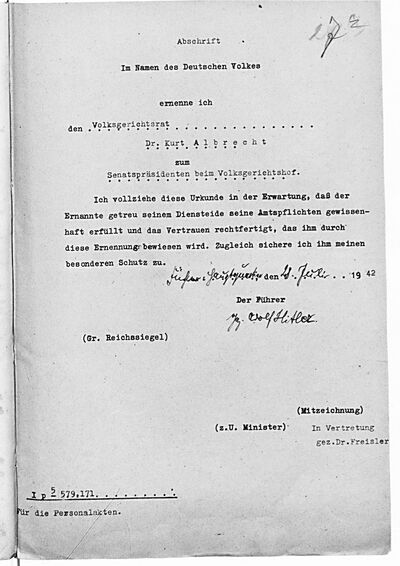
Dr. Kurt Albrecht"s juridical career started in July 1920, when he temporarily replaced a lawyer for several weeks. From August 1920 onwards he was employed at the Public Prosecution Services in Frankfurt, Limburg and Hechingen as special assistant. In July 1927 he was appointed in Frankfurt am Main to public prosecution councilor and in 1933 to district court director. In this capacity he moved at the end of 1934 to the higher labour court in Berlin. Shortly after, on 18th of November 1935, he became assistant judge at the People"s Court and within a few months was promoted there to people"s court councilor. Finally, on 28th of July 1942, nominated by the Reich"s minister of justice, he was appointed to president of the 5. senate of the People"s Court by Adolf Hitler, which underscores Albrecht"s important role within the German justice system at the time.
Kurt Albrecht joined the NSDAP (party) on 1st of May 1933 (member number: 2 655 431). He was not only party member but also part of several NS suborganisations i.e., the National Socialist Airmen Corps, the German Labour Front (Arbeitsfront), the NS-Law Protectors League (Rechtswahrerbund) and the Reich"s League of German Officials (Reichsbund der Deutschen Beamten), the Reich"s Air Raid Protection League (Reichsluftschutzbund), the NS-League for Physical Exercise (Bund für Leibesübungen), the NS-Alumni of German Students League (Altherrenbund der Deutschen Studenten) and the NS-Reich"s Warrior League (Reichskriegerbund). Furthermore, he volunteered as member of the Reich"s judiciary examination office.
The People"s Court (Volksgerichtshof) was established on 24th of April 1934 by law (Law regarding changes of the provisions for penal law and criminal proceedings, "Gesetz zur Änderung von Vorschriften des Strafrechts und des Strafverfahrens" – RGBl. 1934/I S.341), initially as special court. Already two years later, on 18th of April 1936, by "Law regarding the People"s Court and the twenty-fifth change of the ("officials") Remuneration Law" ("Gesetz über den Volksgerichtshof und über die fünfundzwanzigste Änderung des Besoldungsgesetzes" - RGBl. 1936/I S.369) it was declared an ordinary court in terms of the Judicator Act and therefore became part of common jurisdiction. By establishing this new level of jurisdiction an instrument was created which proceeded in unprecedented cruelty against any kind of resistance to the Nazi regime.
How justice desired the judges at the People"s Court to be, was expressed by Fritz Rehn, the first president of the People"s Court: "Gentlemen qualified as judges and gentlemen without judge qualification will work together convicting those people, who have committed the most ignominious crime possible in the National Socialist state: treason." ("Männer mit Richterbefähigung und Männer ohne Richterbefähigung werden in gemeinschaftlicher Arbeit das Urteil sprechen über die Menschen, die sich des schimpflichsten Verbrechens, das es im nationalsozialistischen Staate geben kann, schuldig gemacht haben: des Ver-rats".)
And in August 1937 minister of justice Franz Gürtner called the members of the People"s Court a "Striking force ... for abatement and defense of all attacks on the external and internal security of the Reich." ("Kampftruppe….zur Niederschlagung und Abwehr aller Angriffe gegen die äußere und innere Sicherheit des Reiches.")
Berlin was decreed as location of the People"s Court. Initially it started working with three senates, which were in charge especially of "High treason and treason". Each senate was composed of five judges, of whom only two had to be qualified as such. The 5. senate, of which Dr. Kurt Albrecht was appointed to president in July 1942, was established on 1st of November 1941. A sixth senate was added at the end of year 1942. The 2., 3. and 5. Senates of the People"s Court were so-called "flying senates" (travelling, "fliegende Senate"), which also pronounced sentences in cities other than Berlin. The 5. senate of the People"s Court, presided by Kurt Albrecht e.g., heard cases also in Vienna, the 6. senate from 1943 on in Graz. Usually the members of these "flying senates" came by train for the duration of one week and worked cumulatively on multiple cases within this period.
After the "connection" ("Anschluss") of Austria with the German Reich, on 20th of June 1938 the "Order regarding the introduction of provisions concerning high treason and treason in the land of Austria" ("Verordnung über die Einführung der Vorschriften über Hochverrat und Landesverrat im Land Österreich" - RGBl. 1938/I S.640) was decreed. With this the People"s Court became authorized also in Austria which extended the factual and territorial competency of the court. As criminal offenses to be prosecuted according to Nazi legislation later the damaging of military material and equipment ("Wehrmittelbeschädigung") and economy sabotage, as well as from 1941 onwards, espionage, guerilla warfare (franctireurs), defeatist actions ("Wehrkraftzersetzung"), desertion, and other predominantly political delicts were added. Defendants were unable to lodge appeals for decisions made by the People"s Court, but the public prosecution was.
All cases of high treason or treason were reported by the responsible public prosecution service in Austria to the Reich"s senior public prosecutor"s office in Berlin. It was decided there if a case was heard by a People"s Court senate or by the higher regional court in Vienna (from 1944 onwards also by the one in Graz). This decision by the Reich"s senior prosecutor"s office had a huge impact on the defendant, because after 1940 senates of the People"s Court passed death sentences in about 40 % of the cases. Whereas the respective quota of the higher regional court in Vienna was at around 0.4 %!
For this text published sentences were consulted and evaluated, which were pronounced in Austria by Kurt Albrecht and his colleagues of the 5. senate (the actual number of proceedings presided by Kurt Albrecht cannot be ascertained).
According to this, 146 persons were on trial in 37 proceedings. The accusations were predominantly regarding preparation of high treason ("Vorbereitung zum Hochverrat") and enemy support ("Feindbegünstigung"). Albrecht and his senate passed 81 death sentences (three of those were converted to long lasting penal servitude) and 54 prison or penitentiary sentences. Although twelve defendants were exonerated, it has to be kept in mind that this group of persons was immediately arrested again by the Gestapo (secret political police) and taken to "protective custody" ("Schutzhaft").
Three sentences of the 5. senate are briefly presented in the following as examples:
Death Sentence for Helene Kafka
Helene Kafka (1st of May 1894 – 30th of March 1943) was the daughter of a shoemaker couple. She grew up in Vienna and in the year 1914 joined the Franciscan Order in Vienna-Margareten. As sister she selected the religious name "Maria Restituta". From May 1919 onwards she worked as operation theatre nurse in the municipal hospital Mödling.
Very soon dissident Sister Restituta came into conflict with the Nazi regime. She was unable to accept the disappearance of Jewish doctors or the anticlerical positions of the new rulers. "Sister Resoluta", as she was also called because of her determined appearance, hung crucifixes in a newly opened hospital ward despite a specific ban by the National Socialists in 1941 and refused to remove same. Her fate was sealed by a "soldier song" with anti-government lyrics, which she duplicated with support from a lady working as paralegal.
She was denunciated, arrested by the Gestapo on 18th of February 1942 and on 29th of October of the same year sentenced to death by the 5. senate of the People"s Court presided by Kurt Albrecht for "treasonable enemy support and preparation of high treason" ("landesverräterischer Feindbegünstigung und Vorbereitung zum Hochverrat"). Simultaneously she was convicted to lifetime loss of her civil rights.
One can read in the conviction signed by Kurt Albrecht: “During the [our] most difficult destiny contest the defendant has turned against her people and hand in hand with its sworn enemies worked towards its annihilation. In doing so she has forfeited her right to live within the community of this [our] people, therefore the death sentence was the only appropriate and for protection of the German people required atonement.” ("Die Angeklagte hat sich im schwersten Schicksalskampf gegen ihr Volk gestellt und Hand in Hand mit dessen Todfeinden an der Vernichtung desselben gearbeitet. Damit hat sie das Recht verwirkt, innerhalb der Gemeinschaft dieses Volks zu leben, die Todesstrafe war mithin gegen die Angeklagte die einzig angemessene und zum Schutze des deutschen Volks erforderliche Sühne.")
Despite brutal interrogation means during her arrest, Sister Restituta kept quiet about the soldier’s name who gave her the lyrics as well as about the name of the colleague who had helped her with copying. Eight mercy petitions, including one by Vienna’s archbishop Cardinal Theodor Innitzer, were declined. The nun was executed by guillotine on 30th of March 1943 in the building of Vienna’s district court.
On 21st of June 1988 she was beatified by pope Johannes Paul II.
It is the only known instance in the Third (Nazi) Reich where a nun/sister sentenced to dead by “ordinary” court proceedings was actually executed.
On 19th of November 1997 the district court for criminal cases in Vienna stated by ruling, “that the death sentence of Sister M. Restituta passed by the NS People’s Court on 29th of October 1942 has to be treated as never occurred.” ("dass die durch den NS-Volksgerichtshof am 29.10.1942 ausgesprochene Verurteilung Sr. M. Restitutas zum Tod als nicht erfolgt gilt.")
Death sentences for August Luka and Leopold Segall
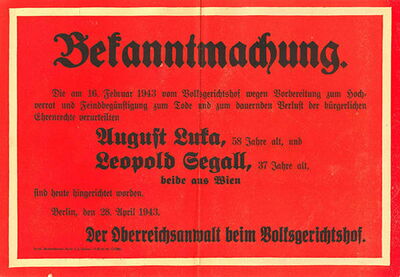
August Luka (18th of November 1884 – 28th of April 1943), welder by profession and Leopold Segall (19th of September 1905 – 28th of April 1943), general manager by profession, were both sentenced to death on 16th of February 1943 by the People’s Court for “preparation of high treason” ("Vorbereitung zum Hochverrat").
Their crime: Creation and distribution of a “communistic flyer” with the text: ”Male and female workers! Always think about this useless bloodshed! It is the blood of your sons, fathers and brothers! [...] Sabotage Hitler’s war machinery, wherever you can! Work as slow as just possible! Every piece less serves the peace! Every piece more prolongs the war! […]“ ("Arbeiter und Arbeiterinnen! Denkt stets an dieses sinnlose Blutvergießen! Es ist das Blut Eurer Söhne, Väter und Brüder! […] Sabotiert Hitlers Kriegsmaschinerie, wo ihr nur könnt! Arbeitet so langsam, wie nur möglich! Jedes Stück weniger dient dem Frieden! Jedes Stück mehr verlängert den Krieg! [...].")
August Luka distributed this flyer at his workplace and, according to Gestapo investigations, handed it to five or six people known to him within the firm for reading.
The general manager Leopold Segall made some copies of this “communistic flyer inviting decrease of work performance”
Both defendants were sentenced to death on 16th of February 1943 by judge Albrecht and his colleagues for preparation of high treason.
The conviction states:
„The defendants have, during the most difficult contest the German people have to pass in their history, raised their hands against it and wanted to contribute to its succumbing to its enemies. Such behavior requires not only in the interest of security for people and nation the eradication of the defendants, the death sentence is also to be regarded as the only appropriate atonement for such kind of crime.” ("Die Angeklagten haben im schwersten Kampfe, den das deutsche Volk in seiner Geschichte zu bestehen hat, die Hand gegen es erhoben und dazu beitragen wollen, daß es seinen Feinden erliege. Ein solches Verhalten erfordert nicht nur im Interesse der Sicherheit von Volk und Staat die Ausmerzung der Angeklagten, die Todesstrafe ist für ein derartiges Verbrechen auch als allein angemessene Sühne anzusehen.")
Furthermore, both were convicted to lifetime loss of their civil rights, and had to bear the costs of the legal proceedings. The typewriter use by Segall for “committing the crime” was confiscated.
Two months after passing the sentence August Luka and Leopold Segall were executed by guillotine on 28th of April 1943 in Berlin-Plötzensee.
The minutes covering the enforcement of judgement on August Luka note with German accuracy:
“At 7:06 pm the convict, hands shackled on his back, was brought in by two prison officials. [...]
After personal identity between presented and convicted was confirmed, the enforcement supervisor instructed execution by the headsman. The convict, who was quiet and composed, let himself being laid without resistance on the guillotine device, then the headsman performed decapitation by the guillotine and thereafter reported the sentence as fulfilled. The whole operation lasted 14 seconds from convict’s first presentation until final confirmation of execution.” ("Um 19.06 Uhr wurde der Verurteilte, die Hände auf dem Rücken gefesselt, durch zwei Gefängnisbeamte vorgeführt. [...] Nach Feststellung der Personengleichheit des Vorgeführten mit dem Verurteilten beauftragte der Vollstreckungsleiter den Scharfrichter mit der Vollstreckung. Der Verurteilte, der ruhig und gefasst war, ließ sich ohne Widerstreben auf das Fallbeilgerät legen, worauf der Scharfrichter die Enthauptung mit dem Fallbeil ausführte und sodann meldete, dass das Urteil vollstreckt sei. Die Vollstreckung dauerte von der Vorführung bis zur Vollzugsmeldung 14 Sekunden.")
Death sentence for Edith Gadawits
On 24th of September 1943 the 19 year old Edith Gadawits (born 18th of August 1924 in Vienna) was indicted together with her codefendants Anna Senhofer (19 years old), Gertrude Hausner (20 years old) and Felix Imre (25 years old) before the 5. senate of the People’s Court, at this date sitting in Krems (Lower Austria). They were accused of “preparation of high treason and enemy support” ("Vorbereitung zum Hochverrat und Feindbegünstigung").
The group belonged to the communist youth organization (KJVÖ) and engaged oneself with anti-Fascist agitation. Many of the partly very young ladies and gentlemen of the youth organization were relentlessly hunted by the Gestapo. The group around Edith Gadawits was blamed for having organizationally prepared for communistic treason by distributing subversive leaflets during the years 1940 and 1941. They generated flyers directed at German frontline soldiers and requested them with same to desert from the army (Wehrmacht).
The defendants Senhofer and Hausner were each sentenced by Kurt Albrecht and his judging colleagues to 12 years of penal servitude and the loss of civil rights for a duration of 10 years.
In favor of both young ladies it was considered that they would still “be able to improve” (“besserungsfähig”) and that “the protection of the Reich would not necessarily require ex-clusion from the community of [German] people.” (“der Schutz des Reiches nicht unbedingt den Ausschluss aus der Volksgemeinschaft erfordere".)
Felix Imre and Edith Gadawits experienced less „clemency“. They were sentenced to death and lifetime loss of their civil rights. As usual, the defendants also had to carry the costs of the legal proceedings.
In the reasons given for the judgement it is stated that, although Edith Gadawits was only 16 or 17 years old at the time of acting, the court nevertheless got the impression that “according to her intellectual and moral/ethical development she should be treated equivalent to an 18 year old person” (“aufgrund ihrer geistigen und sittlichen Entwicklung einer 18 Jahre alten Person gleichzuachten"). Furthermore, “the attempt to disintegrate the fighting frontline by communist propaganda would be the most severe offense [imaginable] to be imputed on the defendant.” ("der Versuch, durch kommunistische Propaganda die kämp-fende Front zu zersetzen, das Schwerste, was der Angeklagten zur Last zu legen sei.“) Later it can be read: “This offense can only be atoned for by death. Consideration of the defendant’s youth [certainly] has to recede when compared to the indispensable necessity to effectively protect frontline and homeland in the current struggle for existence from all subversive and anarchical elements.” ("Diese Tat kann nur mit dem Tod gesühnt werden. Die Rücksicht auf die Jugend der Angeklagten muß zurücktreten gegenüber der unabdingbaren Notwendigkeit, Front und Heimat im jetzigen Kampf um Sein oder Nichtsein wirksam zu schützen vor allen staatsfeindlichen und umstürzlerischen Elementen.")
Felix Imre was executed by guillotine on 2nd of November 1943 in Vienna’s district court.
Shortly after, on 6th of November 1943, Albrecht’s 5. Senate convened for a meeting to decide about a motion by Edith Gadawits‘ counsel/lawyer to reopen the case. The request was dismissed by the judges Albrecht, Cabanis and Schulze-Weckert “with costs to be borne by the convict”.
After this ruling Edith Gadawits was kept seven months in the death row of the district court in Krems, until she got notified in early May 1944 that the Reich’s minister of justice Otto Georg Thierack had converted her death sentence (“with the Führer’s [A.Hitler] authorization”) into a penal servitude of 12 years duration. Edith Gadawits (married Schober), who later shared her fate as contemporary witness with younger generations, survived her “death judge” by 51 years! She died on 6th of March 2013 in Vienna at the age of 88 years.
Kurt Albrecht’s life after WWII can only be retraced with large gaps remaining.
On 22nd of March 1950 he had to answer the state commissioner office for political clarification’s chamber (court) in the land Württemberg-Hohenzollern (French sector). From the sentence can be learned that he resided since summer 1945 in Ostdorf (district Balingen) and worked there as arborist. Because of his “formal liability” (“formalen Belastung”) the chamber (consisting of one chief judge, seven associate judges and one representative of the state commissioner) interlocutory classified him into the group of Major Offenders. He was accused of his work as senate’s president at the People’s Court, thereby significantly supporting the National Socialist tyranny and by this assistance having gained considerable advantages for himself.
In return, the chamber however considered positively, that he produced numerous wit-nesses for the defense, who certified that he was committed “to act according to law and justice and during the war to moderate the constantly harsher becoming legislation by applying extenuating circumstances.” ("nach Recht und Gerechtigkeit zu handeln und wäh-rend des Krieges die immer schärfer werdende Gesetzgebung durch Anwenden von mildernden Umständen […] zu mildern.")
Of the 25 defense witnesses 22 alone were colleagues from the judicial system e.g., the People’s Court councilors Zieger and Georg Ernst Diescher, as well as the Reich’s senior prosecutor Ernst Lautz (topmost public prosecutor at the People’s Court), who at this point in time however was jailed in the military prison (stockade) Landsberg/Lech for a 10 year imprisonment because of war crimes and crime against humanity (pardoned in 1951).
Albrecht argued in front of the chamber that the lawsuits conducted by him “were always performed impartially, factually and correctly” ("stets objektiv, sachlich und korrekt geführt") and to have treated the defendants “always humanely and courteously” ("stets menschlich und höflich behandelt").
For the chamber these testimonies and the presented exculpatory statements of the defense witnesses (so-called “Persilscheine”) were sufficient. Kurt Albrecht, “who appears to be worthy of a more lenient judgement” ("der einer milderen Beurteilung würdig erscheint"), was classified into the group of Lesser Offenders. He was inflicted a probation period of three years, within same he was banned from any political activity. He was pensioned and his promotion to district court director, People’s Court councilor and senate president withdrawn. At the same time he was relegated to public prosecutor councilor. The chamber had no objections regarding payment of his benefits (government pension), but reduced same by 30 % for the duration of his probation period. The arrangement of an administrative fine was abandoned. Consequently, Kurt Albrecht was able, despite a short-term reduction of his pension, to enter his retirement well provided.
For the last years of his life he resided with his second wife in Stuttgart (Gustav-Siegle-Street 7). Since the 1950s years he occupied himself with research on the Upper Swabian baroque and documented his results also photographically.
Dr. Kurt Albrecht passed away on 1st of February 1962 in Stuttgart.
As president of the People’s Court 5. senate, Kurt Albrecht held a distinguished position at the highest German criminal court, which was of significant importance within the system of repression and terror. He was one of those “horrible jurists” (“furchtbare Juristen” Rolf Hochhuth, 1978), who contributed with their inhumane and merciless jurisdiction to the moral fall of the German justice and converted juridical principles with fanatical determination into tools of repression and persecution.
Quellenangaben
Federal Archives Berlin (Bundesarchiv Berlin - BAB, R 3001/50165, R 3001/50166, R 3001, 50167, R 9361-I/23)
Public Record Office Baden-Württemberg, department public record office Sigmaringen (Staatsarchiv Baden Württemberg, Abt. Staatsarchiv Sigmaringen Wü 13 T 2 Nr. 2626)
Sentences of the People’s Court (Urteile des Volksgerichtshofes: VGH 5 H 15/43, 5 H 53/44, 5 H 33/44, 5 H 60/44, 5 H 97/43, 5 H 94/42)
Section news (Nachrichten-Blatt der Sektion Frankfurt am Main) online accessible
Ingo Müller: Furchtbare Juristen, Munich, Knaur, 1989
Günther Wieland: Das war der Volksgerichtshof, Pfaffenweiler, Centaurus- Verl.-Ges., 1989
Andrea Hurton: Vom Pogrom in den Widerstand, Innsbruck, Studienverlag, 2020
Helmut Ortner: Der Hinrichter, Springe, zu Kampen-Verlag, 2012
Correspondence of the fraternity (Burschenschaft) "Allemannia" dated 6th of October 2025