
Karl Bacher was born on May 3, 1859. He was the son of Max Bacher (1827–1902), a Jew from Hechingen (Hohenzollern), and Sophia Bacher, née Strauß, who was from Mainz. He had an older sister, Emilie Goldschmidt (1857–1942), née Bacher. The family lived at Buchgasse 18, and from 1866 onward at Oeder Weg 58 in Frankfurt on the Main. His father, Max, was a co-owner of the firm “P. A. Walther,” a business dealing in carpets and upholstery fabrics founded in 1845 and located at 27 Neue Kräme. According to the 1863 Frankfurt address book, the firm also carried manufactured goods. The 1886 address book lists his father’s occupation as “merchant” and his address as Eschersheimer Landstraße 6, not far from Oeder Weg.
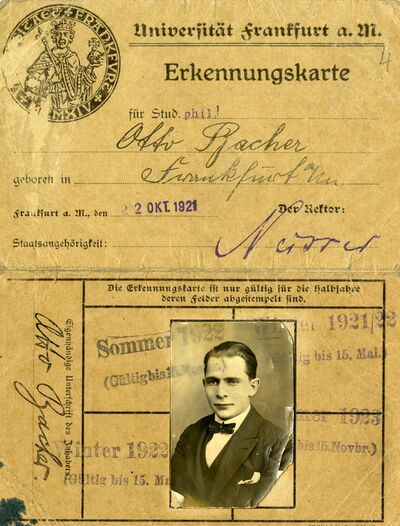
Karl Bacher had been married since May 1889 to Eveline Jeanette (also Joannette) Friedmann, who was born in London in 1866. The couple lived at Königsteiner Street 23, later renamed Freiherr-vom-Stein-Street. According to geni.com, they had two children: Elisabeth Bacher (married name Goldschmidt), born in 1890, and Klara Sophie (married name Ewald), born in 1891. In fact, they also had a son, Otto Bacher, born in Frankfurt on the Main in July 1900. According to his listings in the address books, he had also lived at Königsteiner Street/Freiherr-vom-Stein-Street 23 since at least 1925 and had the same phone number as his father. Dr. Otto Bacher was married to Sofie Heusser. He earned his doctorate from the University of Frankfurt on the Main with a dissertation on the Frankfurt Opera in the 18th century. Starting in 1933, Karl Bacher’s sister Emilie Goldschmidt, who had been widowed at a young age, also lived in the same house.
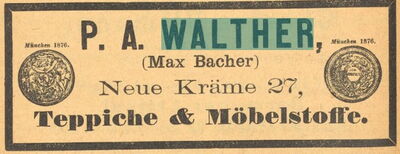
Karl Bacher took over the specialty carpet store “P. A. Walther” from his father as its owner, and his son Dr. Otto Bacher had also been a co-owner of the business—which had moved to Kaiserstreet 5a—since at least 1930. In addition to his membership in the Frankfurt on the Main section of the German and Austrian Alpine Club, Karl was also, for example, a member of the Central German Arts and Crafts Association (Mitteldeutscher Kunstgewerbe-Verein) for decades. He was elected to the board of this association no later than 1903. Bacher was known in particular as a renowned expert on Chinese ceramics, of which he owned a significant collection. With hundreds of loans and through his expert knowledge in this field, he supported, for example, the first major special exhibition in Germany on “Chinese Ceramics,” which the Frankfurt Museum of Decorative Arts presented in 1923. He was also a member of the Society for East Asian Art in Berlin (Gesellschaft für Ostasiatische Kunst Berlin) and thus part of a global network of experts, dealers, and collectors. In early December 1932, at the age of 73, Karl Bacher parted with his collection of Asian art. Numerous ceramics in the collection of the Museum of Applied Art in Frankfurt on the Main today originate from this auction of “one of the finest German private collections of East Asian art” (Adolf Feulner).
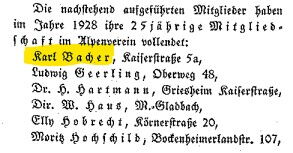
According to the 1925 membership directory of the Frankfurt on Main section of the German and Austrian Alpine Club, Karl Bacher joined in 1904. In the 1905 annual report, he is listed with the first name “Carl.” At the Frankfurt section’s annual general meeting in March 1929, Deputy Recording Clerk Wilhelm Schneider reported that Karl Bacher, residing at Kaiserstreet 5a, had completed 25 years of membership in the Alpine Club. This was reported in the section’s newsletter, the Nachrichten-Blatt, in March 1929. He thus remained loyal to the section through World War I, the revolution, and inflation. However, we currently have no records of Karl Bacher’s activities within the section.
At this time, we do not know whether Karl Bacher resigned from the Frankfurt section of the Alpine Club in 1933. As a member from before 1914, he was not affected by the newly introduced so-called "Arierparagraf" (“Aryan clause”), so it is unlikely that he was expelled from the section—after all, other Jewish members who had also joined the section before 1914 were able to remain members at least until the second half of the 1930s, such as Alfred Carlebach and Artur Marum.
In late May 1933, Karl Bacher, Alfred Oppenheim (1873–1953), and Robert von Hirsch (1883–1977) resigned from their positions as secretaries of the Central German Arts and Crafts Association in response to the anti-Semitic laws enacted by the National Socialists up to that point. It was not until February 1938 that Karl Bacher felt compelled to resign from the Arts and Crafts Association. For him, Nazi repression had particularly severe existential consequences beginning that year and in the years that followed. By July 1939 at the latest, Bacher—who had been a widower since 1934—left his long-time residence at Freiherr vom Stein Street 23 and moved into an apartment at Neuhauß Street 3 in Frankfurt’s Nordend district.
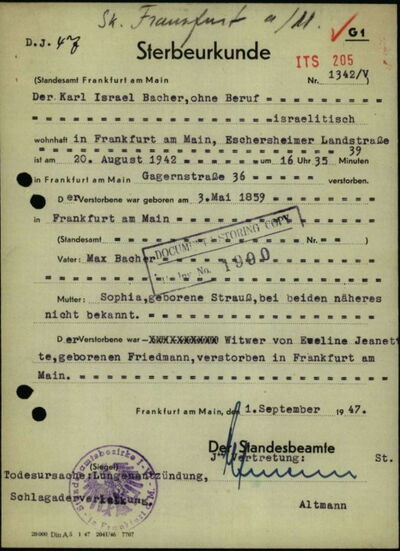
At the age of 83, Karl Bacher was finally forced to move, along with his sister Emilie Goldschmidt, to the “Pension Hoffmann” at 39 Eschersheimer Landstraße on February 1, 1942. Behind this address lay one of Frankfurt’s more than 300 “Jewish houses,” also known as “ghetto houses,” where the Gestapo forcibly gathered persecuted Jews such as Karl and Emilie. A few months later, the siblings’ names appeared under numbers 26 and 188 on the list for the first so-called “elderly transport” XII/1 from Frankfurt on the Main, which, on August 18, 1942, deported more than 1,000 people in train “Da 503” to the so-called Theresienstadt ghetto north of Prague in German-occupied Bohemia. In fact, however, Karl was not deported, presumably because he was already dying. He died shortly thereafter, on August 20, 1942, from complications of arteriosclerosis and pneumonia at the hospital of the Frankfurt Jewish Community at Gagernstreet 36, which had been “Aryanized” in 1939. On August 24, 1942, Karl Bacher was finally buried in Frankfurt on the Main, at the Jewish Cemetery on Rat-Beil-Street. His sister, Emilie Goldschmidt, also did not survive the Shoah. As an inmate of the Theresienstadt concentration camp, she died on September 5, 1942, as a result of the inhumane conditions there.
Karl Bacher’s wife, Eveline, died on June 12, 1934, in Frankfurt on the Main and was buried at the Jewish cemetery there on Rat-Beil-Street. Her death was announced in the July 1934 issue of the newsletter of the Jewish Community of Frankfurt on the Main (Gemeindeblatt der Israelitischen Gemeinde Frankfurt am Main) on p. 445. This demonstrates Bacher’s continued connection to the Jewish community even during the Nazi dictatorship.
His son, Dr. Otto Bacher, managed to flee into exile, probably in 1938. Twenty years later, he was living in Milan, Italy.
His daughter Elisabeth was able to emigrate to Great Britain with her second husband, Robert Eugen Goldschmidt—a banker and co-owner of S. & H. Goldschmidt at 18 Guiollettstreet, who was born in Frankfurt on the Main in 1887. Her husband had been deported from Frankfurt to the Buchenwald concentration camp during the November pogroms and was released from there on December 9, 1938. In September 1939, the couple was living in Hammersmith (London).
Gratitude
We would like to thank Katharina Weiler, an art historian and provenance researcher from Frankfurt on the Main, for the biography of Karl Bacher, to which we have made only a few additions.
Sources and Literature
Hessisches Hauptstaatsarchiv Wiesbaden, HHStAW Bestand 519/3, N0. 1322; Bestand 676, No. 2578 and 7327.
Universitätsarchiv Frankfurt am Main, UAF Bestand 136, No. 163 and Bestand 604, No. 7622.
Gesellschaft für Ostasiatische Kunst Berlin: Viertes Mitgliederverzeichnis, abgeschlossen am 1. Oktober 1929.
Stumbling Stone for Karl Bacher and Emilie Goldschmidt
Ausstellung chinesischer Keramik aus Frankfurter und auswärtigem Privat- und Museumsbesitz, vom Juni bis September 1923. Ausstellungskatalog des Kunstgewerbemuseums Frankfurt am Main. Frankfurt on the Main 1923.
Robert Schmidt (Ed.): Chinesische Keramik von der Han-Zeit bis zum XIX. Jahrhundert. Herausgegeben unter Mitarbeit von Alfred Oppenheim und Karl Bacher. Frankfurt on the Main 1924, online accessible
Hugo Helbing: Sammlung Karl Bacher, Frankfurt am Main: Versteigerung 7. und 8. Dezember 1932. Frankfurt on the Main 1932, online accessible
Thomas Bauer: „Mit lebhaftem Bedauern und aufrichtigem Dank“ – Der Mitteldeutsche Kunstgewerbe-Verein in der Zeit des Nationalsozialismus“. Frankfurt on the Main 2016, online accessible
Katharina Weiler: Durch Raum und Zeit. Objektbiographien aus der Sammlung Cords. In: Kulturgüter, Provenienzen und Restitution. Objektgeschichten aus Frankfurter Museen, Sammlungen und Bibliotheken, ed. by Franziska Kiermeier, Maike Brüggen and Evelyn Brockhoff. Frankfurt on the Main 2023, p. 67-81.
Photo gallery
No images available.