
Paul Ludwig Lion was born on June 13, 1870, in Mannheim. He was the son of Heinrich Lion (1841-1918), a merchant also born in Mannheim, and Clementine Lion, née Maas (1840-1909), born in Frankfurt on the Main. He had an older sister who was also born in Mannheim: Auguste Franziska, married name Hopf (1869-1939). According to the 1870 Mannheim address book, the Lion family lived at No. 1 O.5 in Mannheim, as did Paul's grandfather, the merchant Ludwig Lion. His father Heinrich Lion can also be found at this address in later Mannheim address calendars, for example in those from 1875 and, for the last time, 1880, so that the family must have moved to Frankfurt on the Main in 1881. His father had been running the company "Gebrüder Maas" (Maas Brothers) in this city since 1881, which was then located at Rossmarkt 10 and belonged to Heinrich Lion and Heinrich Maas, who lived in Berlin. Heinrich Lion's family lived at Mittelweg 49 at that time, in Frankfurt's Nordend district. According to the 1885 Frankfurt address book, this factory for wool yarns and colorful embroidery was now located at Gutleut street 7. It now belonged solely to Heinrich Lion and had Josef Winnen as its authorized signatory and Friedrich Hauff and Moritz Hecht as collective authorized signatories.
In 1906, the Lion family lived at Eschersheimer Landstraße 39. They remained there until 1941, so also after Paul Lion's death. He had always worked as a manufacturer of tapestry goods and contributed his experience as a merchant to the work of the advisory center of the Hilfsverein der Juden (Jewish relief organization) in Frankfurt on the Main until his death.
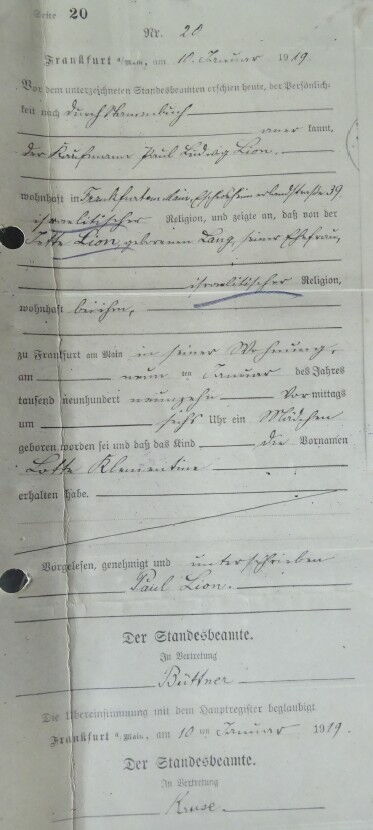
In May 1905, Paul Lion married Henrietta Jetta, known as Jettchen, Lang, who was born in Nuremberg in September 1879. She was also Jewish and the daughter of Ignatz Lang, born in 1837 in Pretzfeld (Ebermannstadt district, Bavaria), and Sabine Reichenberger, born in 1847 in Floss (Neustadt an der Waldnaab district, Bavaria). They had two children: a son, Ernst Lion, born in February 1906 in Frankfurt on the Main, and a daughter, Lotte Klementine (also: Clementine) Lion, born in January 1919 in Frankfurt on the Main. Ernst Lion graduated from high school at the Frankfurt Musterschule in 1925 and joined his father's company in July 1929. Lotte Lion attended the Elisabethenschule from 1929 onwards.
Paul Ludwig Lion has been listed in Frankfurt address books since 1899: at that time, he lived at Stern street 21 (in Frankfurt's Nordend district) and worked as a merchant. Together with his father Heinrich Lion and Josef Winnen, he ran the tapestry factory "Gebr. Maas" at Windmühl street 3, which had been founded in 1824. However, documents from the Hessian State Archives in Wiesbaden indicate that Paul Lion founded the general partnership "Tapisseriewarenfabrik Gebr. Maas Nachf. Lion, Winnen & Co" together with the merchant Josef Winnen in 1890. Consequently, the company appears to have been renamed in 1890, when he was still living in Mannheim. At the end of the 19th century, Friedrich Hauff and Moritz Hecht were "collectively" authorized signatories for the factory. The Maas brothers were relatives on his mother's side. The factory "Gebr. Maas Nachf. Lion, Winnen & Co." was later located at König street 48, today Gräf street 48 (in the Bockenheim district).
In 1930, Paul Lion and Walter Janietz were the only personally liable partners in this company. However, after the National Socialists came to power, Walter Janietz, who had previously been an authorized signatory and, from 1919, a partner, forced his business partner Paul Lion out of the company, which he continued to run alone after this so-called "Arisierung" (Aryanization), i.e., the ousting of the Jewish partner, in January 1935. His wife Frieda Janietz later became a co-owner, and his daughter Erika, who lived in Salmünster (near Frankfurt), became an authorized signatory. After 1945, Walter Janietz ran the company under the name "Textilwerk Walter Janietz Liwico-Garne," with Liwico referring to the former name "Lion, Winnen & Co."
Files in the Hessian State Archives Wiesbaden show that Paul Lion's company was involved in wage disputes with the Verband der Fabrikarbeiter Deutschlands (German Factory Workers' Union) in the second half of the 1920s. The latter demanded higher wages, for example, an increase in the hourly wage for female factory workers over the age of 20 from 53 pfennigs per hour to 55 pfennigs (1927) and then to 56 pfennigs (1928). In each case, arbitration proceedings by the arbitrator for the district of Hesse-Nassau in Hanau were necessary. These proceedings also show that female workers aged 14 and above were employed in the tapestry factory, i.e., girls who started working immediately after completing eight years of compulsory schooling. During the Great Depression, the wage for female factory workers over the age of 20 fell to 52 pfennigs – and for female workers aged 14 to 16 from 30 to just 27 pfennigs! The reason for this, as stated in a letter from the company Lion, Winnen und Co. Gebr. Maas Nachf. dated January 29, 1931, was that the company had been "seit Jahren mit Unterbilanz arbeitet" (operating at a loss for years), i.e., suffering losses, and had therefore already relocated part of its production to Salmünster because wages were lower there.
Paul Lion was a successful factory owner who imported English raw cotton and then sold three-quarters of his tapestry products in Germany and exported one-quarter abroad, for example to France, Italy, the Netherlands, the British Mandate of Palestine, Hungary, and South America. In 1933, the company had 38 employees, 74 workers, and 3 apprentices. Its turnover amounted to RM 1.7 million. In addition, since 1931 he had been the main shareholder (75 percent) of the J. H. Pelet company in Basel (Switzerland). This company had been founded in 1899, but was not converted into a stock corporation until 1931.
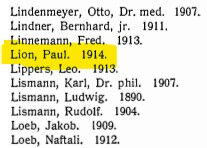
Paul Ludwig Lion joined the Frankfurt on the Main section of the German and Austrian Alpine Club in 1914. Since he is still listed in the 1925 directory of section members with this year of joining, he remained loyal to the Frankfurt section throughout World War I and the post-war turmoil. How he participated in the life of the section is currently unknown to us. However, documents in the Hessian State Archives Wiesbaden show that Paul Lion traveled to the Swiss canton of Ticino in the spring of 1938 and climbed the Feldberg (near Frankfurt) in June 1938, shortly before his death. Furthermore, due to a lack of sources, we are currently unable to say whether he resigned from the Frankfurt on the Main section after the National Socialists came to power in 1933 or whether he was expelled as a Jew.
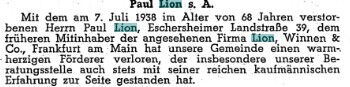
Paul Lion died of cancer on July 7, 1938, in Frankfurt on the Main. His close ties to the Jewish community, even during the Nazi dictatorship, are evident in the fact that the Gemeindeblatt der Israelitischen Kultusgemeinde Frankfurt am Main (community newsletter of the Jewish Community of Frankfurt on the Main) published a short obituary for him in August 1938.
His wife Henrietta Jette Lion lived with their daughter Lotte at Oederweg 11 from July 1941 onwards. After being imprisoned at the end of 1941 in the remand prison/protective custody prison on Starke street, she lived temporarily at the Nussbaum guesthouse at Liebig street 27b and, after another period of imprisonment in April 1942, this time in the Frankfurt police prison, at the Jewish Hospital at Gagern street 36. This hospital was one of the places where Jews were forced to stay before their deportation to the extermination camps. From here, she was deported from Frankfurt in July 1942, but the memorial book published by the Federal Archives does not mention a destination. According to geni.com, Henrietta Jette Lion was murdered in Auschwitz in 1943.
As a Jew, her daughter Lotte was no longer allowed to take her Abitur exams at the Elisabethenschule and therefore had to leave school in the fall of 1936. Instead, she trained as an advertising and fashion illustrator and continued her education as an advertising photographer. However, her plans to emigrate were thwarted. According to the memorial book of the Federal Archives, Lotte Lion was also deported from Frankfurt on the Main to an unknown location in 1942. Here, too, geni.com indicates that she was murdered in Auschwitz in 1943.
His son Ernst Lion had already moved to Basel in September 1933 to work for J. H. Pelet AG. He was granted a residence and work permit in Switzerland. However, Walter Janietz sued Ernst Lion, who was the sole heir of his deceased father and thus retained shares in the company, for damages of RM 204,000 plus interest, and a German court ruled in his favor, reducing Ernst Lion's share by two-thirds. The special tax on domestic assets that he also had to pay, known as the "Judenvermögensabgabe" (Jewish property tax), resulted in the remaining shares in the company, worth over RM 130,000, being confiscated from him.
Ernst Lion moved to France and was interned by the French authorities as an enemy alien in the Recebedou camp in early 1940. In 1941, he escaped from that camp to Spain and finally emigrated to Havana (Cuba) in September 1941. There he called himself Ernesto Lion and obtained Cuban citizenship in 1948. In the 1950s, he stayed in Frankfurt on the Main to assert his legal claim to his parents' inheritance, living at Dominikanergasse 14. His father's former business partner, who had carried out the "Aryanization," tried to prevent these legal claims. Finally, in 1955, Ernst Lion got the property on Gräf street back and, two years later, got some compensation. After the Cuban Revolution, he and his wife had to leave. They moved to Florida (USA) in August 1959. His wife received the German citizenship in 1965. From 1961 onwards, both had a second residence in Frankfurt on the Main, where Ernesto Lion finally died on October 22, 1978.
Sources and Literature
Hessian State Archives Wiesbaden, HHStAW 518 No. 22.500; 519/3 No. 16.710 and 24.502; 2031 No. 199; 2031/1 No. 41 and 184
Stumbling stones for Paul, Jette, Ernst and Lotte Lion
Paul Ludwig Lion on geni.com
Address books for Frankfurt on the Main, online accessable
Bericht der Sektion Frankfurt a. M. des Deutschen und Österreichischen Alpenvereins e.V. 1914. Frankfurt a. M. 1915, online accessable
Bericht der Sektion Frankfurt a. M. des Deutschen und Österreichischen Alpenvereins e.V. 1919-1924. Frankfurt am Main 1925, online accessable
Photo gallery
No images available.