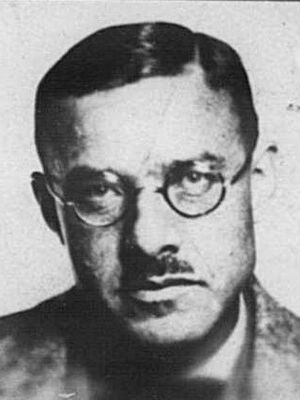
Heinrich Alexander Elsässer was born in Frankfurt/Main on 19th of April 1896 as second child of the merchant Siegmund Elsässer (1857-1919) and his wife Louise Helene, née Weismann (1871-1928). He descended from a Jewish merchant family active in leather trading in Frankfurt since the middle of the 19th century.
Heinrich had a brother and a sister, both also born in Frankfurt. Regarding his younger sister Florentine (born 1911) there is only little information passed on. She married in France, migrated in the 1950ies to Australia and spent her last years in Canberra.
The older brother Otto (born 1894) married 1920 in Frankfurt Marianne Löwy (1895-1981) hailing from Vienna and also of Jewish descendance. Shortly after the couple moved to Stuttgart, where the two sons Erich Ortwin (1922-1940) and Helmut (1925-2002) were born. Otto Elsässer died on 19th of June 1938 in Stuttgart. In the following year his widow married her brother-in-law Heinrich Elsässer.
At the time of Otto’s and Heinrich’s births the family lived at Friedrichstreet in Frankfurt’s Westend quarter and from 1903 to 1933 at Königstreet in the Bockenheim quarter. This street does not exist anymore. Parts of its previous trajectory belong today to the Gräfstreet.
Since 1855 the Elsässer family was busy in leather trading. At this year Isaak Elsässer, Siegmund’s father, founded the business in Frankfurt (directory entry: “Elsässer, Isaak, Schnurgasse 55, Leder, Comm. u. Sped.”), which later resided in the Trierische Gasse (now the southern stretch of Hasengasse). In the directories of these years he is continuously listed as leather trader.
After the death of the company’s founder in 1871, the business was continued within the family. Already one year earlier it traded under the name “I. Elsässer Sons”. Heinrich’s father, Siegmund Elsässer, is traceable as (co-)owner of the company since the 1890ies. Beside his business activities Siegmund Elsässer also made an appearance as composer. However, no details about his musical education are known. His compositional producing is documented by a few creations only and remained circumstantial compared to his mercantile activities. The Frankfurt directory of 1906 lists him as member of the Philharmonic Association (“Philharmonischer Verein”), where he held the position of an assessor. The association itself existed since its foundation in the year 1834. In 1909 S. Elsässer created an anniversary composition for the Philharmonic Association. He also dedicated a military march composition to the Trading Association Frankfurt (“Kaufmännischer Verein Frankfurt am Main”) on the occasion of its 25th anniversary.
Heinrich Elsässer began his education in 1903 at the Wöhler school. Three years later he changed to the Goethe secondary school (Gymnasium), which he attended until 1912 and where he obtained his general certificate of secondary education (“Mittlere Reife”).
After his schooldays Heinrich started a biennial apprenticeship at the company K. & E. Neumond, which was located at Frankfurt’s Schillerstreet. The brothers Karl and Eugen Neumond were active in grain trading. Beside the domicile in Frankfurt, their enterprise maintained further sites in Hamburg and New York.
From the 1st of May 1914 onwards Elsässer continued his commercial education at the international grain trading company Weil Hermanos in Antwerp, which was at this time an important European trading hub. The company possessed close relationships to the Argentinian export trade. With the outbreak of WWI Heinrich Elsässer had to abandon his apprenticeship at Weil Hermanos. After the outbreak of war as German citizen he was regarded as member of a hostile state in Belgium. Consequently, he was dismissed by the company without notice on 4th of August 1914 and detained by the authorities. Afterwards they transferred him to a Belgian internment camp for civilians. From there he managed to escape together with several fellow prisoners.
Via The Netherlands he returned to Germany and immediately reported as war volunteer. Because his conscription did not happen at first, he went to Nuremberg and continued his training at company Leopold Rosenbaum, which was also a grain trading business. In October 1915 he was finally drawn to military service. In the following three years he was employed as infantryman at the western front. In August 1916 he was wounded at Verdun and subsequently contracted diphtheria, which he had to cure in the epidemic plague military hospital near Inor (now Département Meuse, Region Grand Est). In August 1918 he was wounded a second time at Vermandovillers (now Département Somme, Region Hauts-de-France) and discharged from the military hospital only on 12th of January 1919. On the very same day his father Siegmund passed away in Frankfurt. Straight after his discharge from the military hospital Heinrich Elsässer took over his parents’ business and ran it until the death of his mother in 1928 together with her in the Königstreet. Afterwards he operated the company alone without any employees. According to himself this was possible because he had an established client base and earning his living was initially secured.
Heinrich Elsässer joined the Alpine Club in Frankfurt 1921 and initially belonged to the “climbing squad” („Kletterriege“), which was integrated in the mid 1920ies into the “Alpine Tours Association” (“Hochtouristische Vereinigung” HTV). Within this branch of the section he assumed various tasks, amongst others in the admission committee of the HTV, as well temporarily as treasurer and secretary.
Elsässer was an experienced mountaineer, who undertook his tours mostly alone. Occasionally contacts to other mountaineers arose on mountain huts, with which he then executed particular ventures. In the section news Elsässer published detailed reports, sometimes over several parts, about his mountain ascents. Between 1926 and 1931 a total of nine articles were published in which he reported about mountain and ski tours, done predominantly in the Eastern Alps but also in the Western Alps.
His reported summer tours led him to the Ankogel- and Rieserferner-group, to the Kaunergrat- and Geigenkamm-region of the Oetz Valley Alps, to the Zillertal Alps, to the Venediger-group as well as to the Valais Alps. The ski tours likewise published in the section news he undertook in the Silvretta-group, the Dachstein region, the Verwall and in the Sesvenna-Lischana-group.
Among the mountain tours Elsässer reported there are some challenging undertakings, which deserve special attention. He describes solo ascents of the Dreiländerspitze (10,490 ft/3197 m) in the Silvretta-group, of the Rofelewand (11,000 ft/3353 m) in the Oetz Valley Alps via its east ridge (level of difficulty III on the UIAA-scale) and of the – rising on the opposite side - Schwabenkopf (11,085 ft/3378 m) via the south ridge. In his report about mountain tours in the Rieserferner-group Heinrich Elsässer describes the ascent of the Hochgall (11,275 ft/3436 m) via a route he called “east wall” together with a chance acquaintanceship from Vienna, who he had met on the Barmer hut. However, the Hochgall has no “east wall” as such. Therefore, it is probable that Elsässer either climbed the east flank followed by the northeast ridge, or – less likely – the northeast flank subsequently passing over to the northwest ridge. Both variants are challenging highly alpine tours and clearly exceed the level of simple glacier hikes. He had to cancel a planned solo ascent of the Wildgall (10,740 ft/3273 m) in the same mountain group because of adverse conditions. Based on his alpine experience it can be assumed that he could have successfully approached this difficult summit also on his own (solo).
During a stay in the Valais Alps in 1931, which happened simultaneously to the Matterhorn’s north wall being climbed for the first time by the brothers Franz and Toni Schmid, he ascended the Dufourspitze (15,205 ft/4634 m) together with a companion from Munich and a few days later the Rimpfischhorn (13,775 ft/4199 m) alone.
A noteworthy example of the undertakings described by Elsässer is the ski crossing of the eastern Dachstein-group he performed in deep winter conditions on his own from the Brünner hut via the Hirzberg on to Mitterndorf. In doing so he had to overcome considerable difficulties, which he described in his report. The editorship of the section news added an ironical/critical comment to the report, explicitly questioning the execution of this tour as a solo effort.
In his reports Elsässer mentions several times the Vienna mountaineer Dr. Eugen Guido Lammer (1863-1945). In his publications (e.g., in the book “Jungborn” [Fountain of Youth] published in 1922 by the Austrian Alpine Club) Lammer consistently advocated mountaineering without guides and solo efforts – a position apparently shared by Elsässer. That he was moved by these topics and also the person manifests itself also by him giving a presentation about Eugen Guido Lammer at the Alpine Tours Association (HTV) in 1928.
Heinrich Elsässer’s commitment to Frankfurt’s Alpine Club also shows from his lectures given at events of the Alpine Tours Association (HTV). Beside presentations of tours he had already described in the section news, he also talked about mountain hikes in the Sonnblick-group and the Stubai Alps.
For the year 1932 there is also a lantern slide lecture about “Alpine ski tour training with Colonel Bilgeri” documented. Here Georg Bilgeri (1873-1934) is meant, an Austrian ski pioneer and founder of military skiing in Austria.
Also activities of Elsässer in Frankfurt’s closer vicinity are documented. E.g., he offered for the Alpine Tours Association (HTV) a hike in the Vogelsberg (1932) and organized a climbing excursion to the Hohenstein in the Odenwald (1933).
In March 1936 Heinrich Elsässer had a severe accident during a ski tour in the Allgäu Alps, suffering a complex fracture of his right elbow. The consequences of this injury were serious. For the rest of his life his right arm remained substantially degraded in function and hardly useable.
According to his own statement in 1936 he left the Frankfurt Alpine Club “voluntarily”.
With the boycott measures of the National Socialists against Jewish businessmen starting in 1933 the sales revenue on Heinrich Elsässer’s company collapsed massively. In the same year he moved from Königstreet to Fichardstreet 5 within Frankfurt’s Nordend quarter and still continued running his company on a small scale. Later (1958) he wrote about this period: “In early 1938 I realized that it was impossible to continue the business. Attempts to sell it altogether were unsuccessful. The trading stock was unsellable, except for prices generating high losses. Amounts receivable became for the most part non-collectable; many bills of exchange were protested. At the time I had no means to emigrate and continued to live from the little I was able to sell or fetch for cash payments.”
On 17th of January 1938 Heinrich Elsässer received a summoning to the state police station Frankfurt, where he was requested to leave Germany latest by the 1st of March 1938. He was not accused of any “particular act of wrong-doing” (“besonderes Vergehen”). Shortly after, the deadline was extended until 30th of June 1938 because his intense efforts to find a possibility to emigrate remained in vain. In a letter to the “Reich Minister of the Interior – via the state police station Frankfurt am Main” Elsässer eventually asked for annulment of the order. As for the reasons he referred to the sudden death of his brother Otto in Stuttgart, who left a wife, her highly aged mother and two children.
On this he wrote: “It is my duty to assist my brother’s children as far as possible and to care for them, and I also intend not to abdicate from this responsibility, especially because there is no other male family member, who could take over this obligation!”
On 12th of July 1938 Heinrich Elsässer was placed into police custody in Frankfurt. In the protective custody arrest warrant of the secret state police (Gestapo), formally signed by its head Reinhard Heydrich, as reasons were stated he would give “by his behavior as non-aryan reasons for the apprehension that, if released, he would ignore the orders issued for protection of the German people.”
On 20th of August 1938 he was deported from Frankfurt to the concentration camp Dachau. On 22nd of September 1938 he was transferred to the concentration camp Buchenwald, from where he was released on 28th of April 1939.
While Heinrich Elsässer was detained in the concentration camps Dachau and Buchenwald, his close friend Alex Jacobsohn took on the liquidation of the company still existing on an only small scale. Elsässer had authorized him respectively in time.
At the same time Jacobsohn closed Elsässer’s apartment in the Fichardstreet because he did not expect a speedy disimprisonment of his friend from Buchenwald. As was common in such cases, furniture and objects of value could only be sold far below their actual worth.
In a sworn declaration, which Heinrich Elsässer submitted 1956 via his lawyer to the reparation authority in Wiesbaden, he stated to have owned in his apartment well preserved furniture, as well as valuable pictures and a comprehensive library. Furthermore, he wrote: “I never saw anything of these furnishings again.” He never met his friend and backer Alex Jacobsohn again. He was deported in November 1938 to Buchenwald and murdered there a few weeks later.
After his release from the concentration camp Buchenwald end of April 1939 Heinrich Elsässer had no own apartment available any more. Already a few days later he was registered with the police in Frankfurt at the address Merianstreet 31. It is to be assumed that since 1938 Jewish residents were pooled together by force in the Merianstreet. If the house at Merianstreet 31 was exclusively or predominantly inhabited by Jews already in 1939, cannot be confirmed on the basis of the currently known sources, though.
However, he stayed there only for a few weeks. According to his own statement he “escaped for another three months to Stuttgart, to avoid the Gestapo [secret police]”.
In Stuttgart lived the widow of his late brother Otto with their two minor sons Erich and Helmut. On 5th of July 1939 Heinrich Elsässer married his sister-in-law Marianne. Several circumstances indicate that this marriage primarily served practical purposes, because it happened during a period of intense emigration efforts by Heinrich. Marianne Elsässer was working as secretary at the Belgian consulate and therefore had contacts available, which could matter for departure procedures. Already in July 1938 she had received a letter from Heinrich’s lawyer, which is related to his emigration efforts. In this letter she was asked to intercede for him and to “immediately go with a recommendation of her consul to the American consulate general and to ask there if for him a special letter of comfort/guarantee [...] could possibly be obtained.”
He left Stuttgart in early November 1939, traveled to Le Verdon at the French Atlantic coast and emigrated from there on board the “S.S. Manhattan” to New York, where he arrived on 15th of November 1939.
Marianne Elsässer followed a few weeks later. She traveled to Rotterdam and was able to leave from there on board the “S.S. Rotterdam” also to the USA and arrived in New York on 2nd of December 1939. Her son Erich was at this point in time in Berlin, where he died in the year 1940. Her son Helmut lived at the time in Maidenhead in England. The circumstances of his entry are unknown. But his stay is probably connected to the rescue campaigns for Jewish children, which were brought to Great Britain since the end of the 1930ies. In 1944 he migrated to the USA and later assumed there the name Henry Howard Elliott.
In her application for naturalization completed in 1940 Marianne Elsässer stated to be divorced from Heinrich Elsässer (“We are divorced”). When and where the divorce happened cannot be verified. Their further paths of life also argue for a separation: Heinrich settled in Denver (Colorado), Marianne in California (San Francisco and Ventura). In 1950 Marianne Elsässer married in San Francisco Marcus Jacob Pels (1888-1956), who hailed from Emden (East Frisia). She passed away on 31st of October 1981 and is buried at the Salem Memorial Park and Garden cemetery in Colma, California.
Heinrich Elsässer left Germany completely penniless. In the USA he later called himself Henry Elsen. In a letter from the year 1954 to the reparation authority at the district president in Wiesbaden his lawyer stated: “On emigration he could not take more than 10 RM with him. This amount represented his whole wealth.”
During the first years after his arrival Elsässer had no regular earnings. Only from 1943 onwards he obtained a steady – although very low - income again, but it was hardly more than sustenance. Against the background of the manpower shortage arisen after the USA’s entry of the war he managed to find permanent employment as assistant accountant in a factory. Nevertheless, his economic situation remained tense in the long-term. How his professional life developed in the late 1950ies is unknown. However, it is certain that his economic circumstances continued to be difficult. Contributing to this were also the lengthy proceedings under the responsibility of the restitution authority in Wiesbaden. Over many years Elsässer and his lawyers were forced to struggle for a fair compensation.
In a letter to the responsible authority dated September 1958 – almost twenty years after his escape from Germany – he expressed his situation with obvious resignation: “I ask myself how much longer I have to wait, or how old I have to become to see any progress regarding this ugly issue – I am now 62 years old [...] Please let me know what can be done.”
Much of his life in the USA remains in the dark. Heinrich Elsässer/Henry Elsen passed away in March 1963 in Denver, Colorado. Presumably he saw his familiar alpine world never again after his emigration.
Quellenangaben
Hessian Main Public Record Office (Hessisches Hauptstaatsarchiv Wiesbaden) - HHStAW, Dept. 518, No. 74466, HHStAW, Dept. 519/3, Nos. 10246 and 10264, HHStAW, Dept. 474/3, No. 2369
Section news (Mitteilungsblätter der Sektion Frankfurt am Main), online accessible
Directories of the city Frankfurt am Main, online accessible
Email message of Stephen Elliott (great-nephew of Heinrich Elsässer) dated 15th of January 2026