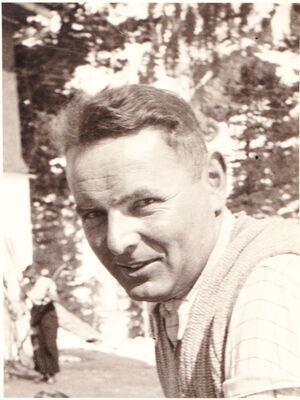
Jean Braumann was born on 23rd of April 1908 in Frankfurt am Main as son of Johann Heinrich Braumann (born 1864) and Anna Christina Braumann (née Eisenhuth, 1875). His parents had married in 1897. About Jean"s schooling we have currently no information.
In October 1937 he married in Frankfurt Maria Margarete, née Bader (born 26th of July 1912), probably the daughter of pastry chef Hans Bader. According to our knowledge the Braumann couple resided in Saalburgstraße 2 in Frankfurt-Bornheim. After Jean Braumann was drafted to service in 1939, Margarete Braumann continued to live there.
Regarding Jean Braumann"s biography outside of the Alpine Club"s Frankfurt section we hardly got any information. Basically, we can only resort to the statements of his wife Margarete Braumann during the posthumous denazification process after 1945. We were only partially able to verify this data from additional sources.
The legal proceedings regarding Jean Braumann were based on article 37 of the "Law concerning the Liberation from National Socialism and Militarism" (Gesetz zur Befreiung von Nationalsozialismus und Militarismus) issued 1946 for the American occupation zone. According to the law, in case the assessed was deceased, "by order of the Minister for Political Liberation proceedings for complete or partial confiscation of domestic inheritance without consideration of any legal succession or testamentary disposition are (potentially) to be executed. Proceedings shall only be ordered in case the concerned is found to be a Major Offender or Offender according to this law." For his widow the outcome of this process also determined her economic future.
In the registration (and questionnaire for the legal proceedings Jean Braumann"s occupational title is stated as "leather merchant". According to his widow he was no member of the NSDAP (party) or of any other Nazi organization, but belonged as staff sergeant (Oberscharführer) from the middle of 1942 until his death in April 1945 to the Armored-SS (Waffen-SS).
Information regarding Braumann's professional career was provided in the registration form by Friedrich Arnold, a longtime colleague and business associate of Jean Braumann. According to this, Braumann joined in 1922 as apprentice the Jewish company for leather goods Marcus Blaut, Hanauer Landstraße 136, where Arnold already worked at the time. Both were employed there until early in 1939 when they jointly founded the company Arnold & Braumann. However, the cooperation lasted only until August 1939 because Jean Braumann had been drafted in 1939 into a police formation.
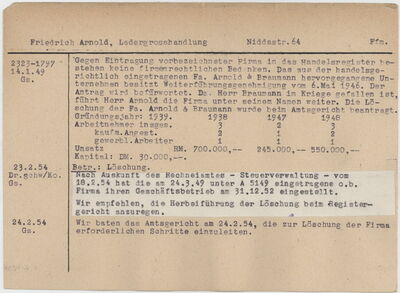
Arnold further stated that his own company was closed in 1943 "and all office employees and workers were drafted or mobilized to other duties because it had not been active in the sense of Nazi ideology." However, the Chamber of Trade & Industry Frankfurt (IHK) noted 1939 on the record chart registering the company "Arnold & Braumann, Dahlmannstr. 23, wholesale trade with leather", that Friedrich Arnold had been "Pg.", means NSDAP party member (see above picture.
Regarding her husband, Margarete Braumann provided information similar to Arnold in the proceedings" questionnaire: Jean Braumann had been warehouse clerk since 1922 at company Marcus Blaut, Hanauer Landstraße 136, which had been later renamed to Leder AG. According to her the joint company with Arnold was located in Lange Straße 18.
In Frankfurt"s telephone directory 1937 for the location Hanauer Landstraße 136 the entry "Blaut, M., leather manufactory, Leder-Aktiengesellschaft (leather stock company)" is found. Then, in 1938 "Leder AG" is listed. As far as we know so far, the company Marcus Blaut OHG (general partnership) was probably Arianized at the end of the 1930s. The shareholders at this time, Arthur and Julius Blaut, presumably sons of company founder Marcus Blaut, emigrated probably 1938/39 at first to Great Britain. Later they apparently moved, possibly with interstations in Latin America, to the USA. We are currently searching for more detailed information concerning their emigration
In connection with the denazification process of her husband Margarete Braumann also completed her own denazification registration and questionnaire. According to her entries she was "via Alpine Club membership" member of the Nazi Reich Association for Physical Exercise (NS-Reichsbund für Leibesübungen) and of the Nation Socialist People Welfare (Volkswohlfahrt, NSV). We couldn"t find out how actively she participated in these organisations.
According to this form Margarete Braumann worked in the early 1930s years as trade assistant in the pastry shop of her father Hans Bader. After her marriage she apparently stopped her professional life, but resumed it after 1945.
After closure of his denazification process war victim Jean Braumann was exonerated - despite his membership in the Armored-SS (Waffen-SS). In February 1948 the responsible Hessian Minister for Political Liberation decided that no (property confiscation) proceedings according to article 37 of the "Law concerning the Liberation from National Socialism and Militarism" will be held.
Jean Braumann"s mother passed away on 10th of April 1945. At this point of time she was already widowed and resided at Berger Straße 286 in Frankfurt-Bornheim.
Jean Braumann is first mentioned in the section news (Nachrichtenblatt) in late 1930: in an announcement for a hike of the "Jungmannschaft" (young men, age 18-27) to be led by him in coming February. At this time the "Jungmannschaft" was still a new group within the section because it was only established in 1929/30. Afterwards Braumann appeared here regularly, repeatedly led hikes and climbing excursions and gave some presentations as well.
His involvement increased significantly from 1933 onwards. After the apparently turbulent extraordinary general meeting in July, where the section's leadership was newly elected, and the structure of the club was aligned with the specifications issued by the Nazi regime, Jean Braumann became head of the "Jungmannschaft" in the second half of the year – and after that, as mentioned in the section newsletter a few months later, also head of the youth group (younger than 18). The reason given was that his predecessor in the positions, the prospective teacher Walter Baecker, had been "transferred". We suspect that the transfer was for professional reasons. Baecker had only taken over the positions from the new section leader Ernst Wildberger in summer 1933. Wildberger, a member of the NSDAP and SA, had declared himself section leader after the extraordinary meeting in July.
The restructuring could be related to indications already showing planned integration of the club's youth groups into the Hitler Youth (Hitlerjugend, HJ). For example, it was stated in the section news in September/October 1933 that one now had to wait until relationships with Hitler Youth were clarified and further guidance received from the "Leader of [Alpine Club] Sections in the German Reich". At the end of 1933, the youth group and the young men's group were merged, the reason given being a decline in membership in the youth group, presumably because the age group was being absorbed into the Hitler Youth.
Braumann getting a leadership role as early as 1933 indicates that he was already at this time considered reliable with respect to the ideology of the new regime. However, it is noteworthy that only the section news (Nachrichtenblatt) of February 1934 reports his registration as a new member of the Frankfurt section. The reasons for this are currently unknown – we can only speculate that his missing membership had simply been overlooked, but now had to be corrected because of his important function.
Already in March 1934 the section news (Nachrichtenblatt) reports that the new section chairman Rudolf Seng, elected in February, had appointed Braumann to the advisory board as member for youth and "Jungmannschaft" (young men). With this, at age 25 he was member of the most important section committee. The members – according to the new statutes conforming to Nazi regime specifications – were not elected any more, but they were appointed by the section"s leader.
During Braumann's tenure as group leader in 1934 an already militaristic diction is noticeable. In February the "Jungmannschaft" invited to three evening shooting competitions, and there were night marches designated as "military sporting drill" or "marching exercise". "The attendance at these military exercises must improve" is stated in a report signed by "Br.". The initials could indicate Braumann as the author.
The section news (Nachrichtenblatt) of May 1934 indicates that the number of attendees in the "Jungmannschaft" was apparently decreasing. It is stated verbatim that "especially for the Jungmannschaft" the "active participation of many members in SS (Schutzstaffel), SA (Sturmabteilung) and Stahlhelm ("Steel Helmet", Alliance of [WWI] Frontline Soldiers) became noticeable". Nonetheless, there had been many events and the "mountaineering enthusiasm" would be great. In 1936 the "Jungmannschaft" was reportedly growing again, as well as the youth group.
In 1937 Braumann got an additional function: He became Deputy Hut Warden for the clubhouse in Oberreifenberg (Taunus), that the section had rented since 1935 from the Nazi organization "German Labour Front" (Deutsche Arbeitsfront). Its previous owner, the society "Youth center for the Christian Unions" (Jugendheim der christlichen Gewerkschaften) had been expropriated by the Nazi regime.
In the following the war preparations of Nazi Germany made itself progressively felt. Caused by increasing calls of the younger members to compulsory services in army and labor duty, the number of participants in hiking tours, climbing or ski excursions reduced. Nevertheless, also still in 1939 activities led by Braumann are reported: at Easter a hike of the "Jungmannschaft", in May a bicycle tour jointly organized by "Gretel and Jonny Braumann", as stated in the section news (Nachrichtenblatt). It is assumed that these two names represent himself and his wife Margarete.
In August 1939 Braumann announced a hike along the Rhine river for October. But it was dropped because the war broke out: After the invasion of Poland in September 1939 all section events were cancelled until further notice – together with an appeal in the section news (Nachrichtenblatt) to please keep in touch with the drafted section members via army postal services.
Also Braumann was drafted, as was almost the complete "Jungmannschaft". In the December 1939 section news (Nachrichtenblatt) his name is listed under "Soldiers in the Field": "Soldier Braumann, SS-Police Division, 14th Pol.-Regiment 1, Zielenzig (Neumark)" (Sulecin, Western Poland).
According to his wife Margarete Jean Braumann was drafted in 1939 "to the auxiliary police". More precise is the entry in the December section news (Nachrichtenblatt) of the Frankfurt section in the German Alpine Club: Braumann is listed with the comment "SS-Police Division, 14th Pol.-Regiment 1, Zielenzig (Neumark)" The town Zielenzig, now Sulecin, is located in Western Poland, about 31 miles (50 km) from the city Frankfurt/Oder.
The data in the section news corresponds to information found in the "Encyclopedia of the Wehrmacht" (Lexikon der Wehrmacht) about the Police Division deployed on Hitler"s orders in October 1939 and its further activities. Initial deployment location of the Police Division was the military training ground Wandern in the vicinity of Zielenzig.
According to the "Encyclopedia of the Wehrmacht" the Police Division participated from mid 1940 onward in the France campaign, was one year later mobilized to what was then East Prussia and subsequently fought for a long time in Russia. It was restructured several times and in summer 1940, on Himmler's request, renamed to SS-Police Division. Acc. to the same source in April 1941 it was integrated into the Armed-SS (Waffen-SS).
Finally, on 10th of February 1942 "all policemen, who weren"t already SS members, were incorporated into the SS" (Encyclopedia). It means that latest since this date also Braumann was probably member of the SS. There exists an individual SS-file for him in the Federal Archives in Berlin, and we are in the process to obtain access soon.
The SS-Police Division in which Jean Braumann was serving repeatedly participated in heavy combat. In autumn 1942 he, sergeant (corporal) at the time, received together with hundreds of other soldiers the Cross for Warfare Merit 2nd Class with swords ("Kriegsverdienstkreuz 2. Klasse mit Schwertern"). The respective entry can be found on the bestowal of decorations list dated 28th of September 1942, signed by Alfred Wünnenberg, lieutenant general and commander of the SS-Police Division. As location of the bestowal the division's command post is denoted, which should have been at this date the front close to Leningrad (St. Petersburg, Russia). Braumann is listed as no. 272 with the note "Sergeant, SS-Police Riflemen Regiment 1". You can find the list in the attachment below.
The "Kriegsverdienstkreuz" was an award bestowed by the Nazi regime in high numbers to military staff and civilians alike as reward for bravery in operations not directly connected to combat missions – e.g., logistics/supply operations or similar.
About Jean Braumann"s subsequent missions during the war we currently have no information available. His widow Margarete Braumann declared in the posthumous denazification proceedings that her husband was from the middle of 1942 until his death in April 1945 staff sergeant (Oberscharführer) with the Armored-SS (Waffen-SS): "He fell on 24th of April 1945 near Schwedt/Oder" (administrative district Uckermark, Brandenburg). His death certificate states Hohenfelde on Oder (river), today part of the town Schwedt. In April 1945 heavy fighting took place in Schwedt because of the Soviet Russian Red Army's offensive towards Berlin. This advance, resulting in ten thousands of military and civilian casualties, finally sealed the end of World War II a few days after Braumann's death.
During WWII members of the SS-Police Division have committed a multitude of, sometimes severe, war crimes. We currently have no information if at all or to which extent Jean Braumann did participate in same.
To date we have no knowledge about any descendants of Jean and Margarete Braumann. After the war Margarete Braumann became again or continued to be actively engaged in the club. Section news 8/1949 (Nachrichtenblatt) contains a short, excited report of her about a section lecture titled "Mountains, Flowers, Animals". In issue 1/1955 she is listed as one of the members having donated for the annual section festival (Alpenvereinsfest). Apparently she continued to live at least until 1960 in Saalburgstraße 2 in Frankfurt.
Friedrich Arnold, former companion of Jean Braumann in the joint company, in 1946 obtained the permit to continue business activities. After Braumann's death became official, the company was newly registered in 1949 under the name "Friedrich Arnold, Ledergrosshandlung" (Leather Holesale House), with registered office in Niddastraße 64, Frankfurt (see photo). At the end of 1952 it discontinued business operations.
We continue our research regarding Jean Braumann and certainly do appreciate any respective hints.
Sources and Literature
Address books city of Frankfurt/Main
Ancestry.de, Death Certifcate Jean Braumann, accessed 19th of October 2025
Encyclopedia of the Wehrmacht (Lexikon der Wehrmacht)
Federal Archive-Military Archive (Bundesarchiv-Militärarchiv) Freiburg: Sign. RH 7/1794
"Gesetz zur Befreiung von Nationalsozialismus und Militarismus" (Denazification law), in: Gesetz- und Verordnungsblatt für Groß-Hessen vom 15. März 1946, accessed online on 15th February 2026
Hessisches Hauptstaatsarchiv: HHStAW Abt. 520/11, Nr. 38596
Hessian Economy Archive (Hessisches Wirtschaftsarchiv): HWA Abt. 3, Nr. 3357_0163-0166 (company Blaut); Nr. 3342_0163 (company Friedr. Arnold); and Nr. 3342_0144 (company Arnold+Braumann)
Section News (Nachrichtenblätter) of the Alpine Club in Frankfurt/Main online accessible
Photo gallery
No images available.