Egon Ewald Pribram was born on 10th of July 1885 in Czernowitz (Bukovina, now Tscherniwzi, Western Ukraine, then under Habsburg rule as part of the k.u.k. monarchy) and baptized as Catholic on 21st of September in the same year. He descended from a well-known Jewish family of scientists, mainly physicians emerged from, amongst others his grandfather Emanuel Pribram (1812-1872, doctor in Prague), his uncle Alfred Pribram (1841-1912, professor for internal medicine and pathology in Prague), and his cousin Hugo Pribram (1881-1943, professor for internal medicine in Prague, who was murdered 1943 in the concentration camp Theresienstadt).
His parents were the professor for chemistry, Richard Pribram (1847-1928) and his wife Ida, née Winterstein (1862-?). Egon Pribram also had a brother, Bruno Oskar, born 1887, who was a physician, too and taught until 1933 as professor for surgery at the university in Berlin. He was able to emigrate 1938 to Great Britain and later to the USA.
On 26th of July 1922 Egon Pribram married in Giessen Margarete Rau, born 3rd of March 1897 in Wiesbaden, who also descended from a Jewish family. The couple got two daughters in Giessen (Vera, born 3rd of August 1925 and Doris, born 16th of April 1927). The marriage was divorced in February 1933. However, Egon Pribram and his former wife remained in close contact also afterwards. It is to be assumed that they later remarried, because after Egon’s death Margarete applied for a widow’s pension. Also she is referred to in the available files of the reparation authority as “wife”, “widow” and “sole heiress”.
She migrated with the daughters in February 1946 to the USA. Margarete Pribram was a physician as well. The Frankfurt directory of 1935 lists her as “Dr. med.” under the address Beethovenstreet 15. If she continued to work as physician later is unclear.
From 1895 onwards Egon Pribram attended the German state secondary school (Deutsches Staatsgymnasium) in Prague, where he passed his school leaving examination (Matura/Abitur). By the way: within the same period (1893-1901) also Franz Kafka was a pupil of this secondary school. After his school leaving examination Egon Pilgram started studies of medicine at the universities Prague, Munich and Vienna, which he completed in 1909 with his PhD thesis. Already three years earlier he published in the “Journal of Physiological Chemistry” his first professional article. He specialized later in gynecology, but first got himself upskilled in the domain of bacteriology at the hygienic institute of the university Munich and in the subject of surgery at the surgical university clinics in Vienna (1910-1913) and Leipzig (1913-1920). His education in Leipzig was, however, interrupted for a long time because he served for almost the whole duration of WWI as chief physician of the 3rd Mobile Surgeons Group of the Vienna surgical clinic in combat zones at the eastern frontline. The main task of this group was performing early surgery and treating wounds on badly injured patients with shots in the head and the abdomen. Often this happened under difficult and dangerous conditions. In this regard his supervisor attested him special merits because of his operational efficiency and praised his organizing ability. In March 1918 he got seriously wounded himself in an accident, but was able to resume his work in the Surgeons Group once more shortly before the end of war.
In 1920 Egon Pribram joined the university’s gynecological hospital in Giessen as resident physician, received his license to teach on 10th of January 1923 there and was appointed adjunct/associate professor on 15th of December 1927. His professorial dissertation dealt with the “Question of Cholesterol Metabolism during Pregnancy and in Childbed” (Frage des Cholesterinstoffwechsels während der Schwangerschaft und im Wochenbett). From 1923 to 1933 he lectured at the university Giessen in the subject areas gynaecology and obstetrics. Beside fundamental research he engaged himself intensely in oncology (carcinosis).
The professor in ordinary and director of the university’s gynaecological hospital, Rudolf Theodor von Jaschke, painted a positive picture of Egon Pribram: “He has proven himself as an extraordinarily proficient, philanthropic doctor, always helpful and pleasant colleague, displayed active scientific engagement and at various occasions demonstrated, that he is an excellently skilled physician as well as surgeon. He has a distinguished way of treating female patients.”
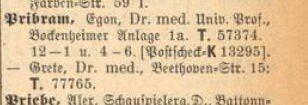
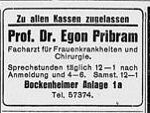
Since 1st of February 1929 Egon Pribram worked as chief physician of the gynaecological clinic of Frankfurt’s Bethany hospital. At this time he lived with his family at Bockenheimer Anlage 1a in Frankfurt’s Westend quarter. At the same address Egon Pribram was also practicing physician in his own specialized doctor’s practice for gynaecology.
From the university calendars of Giessen’s university one can learn that he was still listed there as adjunct professor even after his move to Frankfurt and gave seminars and lectures once a week until his dismissal from university deployment (“Obstetric seminar” [Geburtshilfliches Seminar] and “Selected aspects of the physiology and pathology of women” [Ausgewählte Kapitel aus der Physiologie und Pathologie der Frau]).
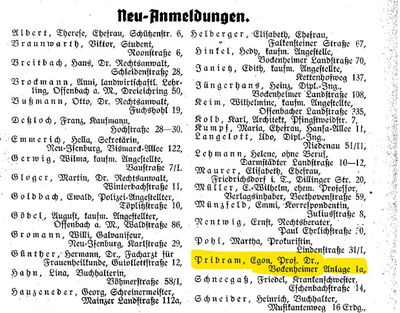
In its March 1937 issue the newsletter of the Frankfurt section lists Prof. Dr. Egon Pribram under new applications (since April 1932 there was no distinction between “new applications” and “new admissions” any more). It cannot be reconstructed any more if he was actually accepted as “regular member”, because his admission should not have been permitted according to the section statutes adopted in February 1934. Because of his Jewish parents, according to National Socialists “racial laws” he would have had to be considered as Jew, despite being baptized as Catholic. It is to be suspected that Egon Pribram identified himself as Catholic in his application for admission and concealed the Jewish parents.
After the so-called Law for the Restitution of Professional Civil Service had been issued on 7th of April 1933 Egon Pribram was dismissed by the medical faculty of Giessen’s university on 20th of July 1933. His name was promptly erased from the university calendar. Although Egon’s parents had had him baptized as Catholic, he was classified as per the parlance used at the time as so-called “non-aryan Christian” or “non-aryan Catholic”. According to Nazi race ideology, these persons were persecuted as Jews by the National Socialists. All excluding and bullying measures hit them the same way as the Jews. Warum galt er nicht als WWI “Frontkämpfer”? Weil kein Deutscher, sondern Österreicher = Ausländer?
On 11th of October 1937 Egon Pribram was arrested in Frankfurt on the purported suspicion of forgery of documents and offence against passport regulations and against the title law. On 8th of February 1938 he was sentenced by the mixed bench court Frankfurt, taking into account the time in pre-trial confinement, to 8 months of imprisonment. He served the sentence in Frankfurt-Höchst until his discharge from prison on 9th of July 1938. Shortly after, on 30th of July 1938 he was abducted to the concentration camp Buchenwald, from which he was released on 22nd of April 1939 with the order to leave Germany within the following three days.
In a sworn declaration to the reparation authority in Wiesbaden Egon Pribram wrote in 1954 that an amount of 5,000 RM had been transferred to him in Buchenwald. He received this amount because in the meantime all his furnishings of the apartment and the doctor’s practice had been auctioned at crash prices. But at his release the money was “seized by the SS under threat” as he later reported. Therefore, he never did receive any adequate equivalent value for the undersold items.
On 25th of April 1939 Egon Pribram escaped from Hamburg to Shanghai, where he immediately began to work again as physician within his own doctor’s practice. However, he managed to do so only with the financial support of American friends and a local physician. About his time in Shanghai he later wrote:
“I arrived in Shanghai completely penniless and initially had to make a living with money provisionary borrowed from acquaintances. Gradually I have earned in a newly established doctor’s practice enough to repay some of my debts. Then, I had to escape another time, this time from the Chinese communists, to the USA and again have lost everything, which I had built there. Again, I was depending on external assistance and now still have to work hard despite my age to earn a living.”
On 8th of December 1948 Prof. Dr. Egon Pribram fled to the USA, leaving behind his apartment furnishings and his doctor’s practice, again. There he was initially not permitted to work in his profession as physician, because according to US laws he had not immigrated “orderly”. Only in February 1950 he was able to meet all formalities, so that he traveled for one day to Canada to immigrate from there in conformance with the law. To open a doctor’s practice in Cleveland/Ohio, where Egon Pribram lived by now, he still had to take a series of examinations. He passed his license exam for the state of Ohio finally in January 1952. Two months later he was at last able to continue his long interrupted professional life as physician. Because at first he was without funds, a physician acquainted with him included him in his doctor’s office, which he left again in March 1954 to open shortly after, aged 69 years, his own doctor’s practice in Cleveland/Ohio.
Two years before his death he traveled to Europe again, but it is unclear if he visited Germany on this trip, too. We also have no knowledge about the further paths of life of his daughters. Egon Pribram passed away on 30th of July 1963 in Cleveland, Ohio, his wife Margarete on 2nd of December 1980. Both’ graves are on the Catholic “Calvary Cemetery” in Cleveland.
Quellenangaben
Sources and Literature
Hessian Main Public Record Office (Hessisches Hauptstaatsarchiv Wiesbaden) - HHStAW, Dept. 518, Nos. 595 and 26583
Frankfurt adress books, online accessible
University calendars Giessen university 1923-1933
Dross F., Frobenius W., Thum A., „We cannot turn their destiny“ ("Wir können ihr Geschick nicht wenden"), memorial book of the German Society for Gynaecology, 2020, Hentrich & Hentrich, pages 190-192
University archives of the Justus-Liebig-university Giessen - PrA Med. No.10
Section news (Nachrichten-Blatt der Alpenvereinssektion Frankfurt am Main), online accessible